In this article9 sections · 6 min
How the scam works
Google describes the pattern on its own help page: a sudden increase in one-star and two-star reviews, followed by someone demanding money, goods or services in exchange for removing them. The demand may come by email, text, WhatsApp, a messaging app or a direct message, and it often presents itself as a "reputation service" that can make the problem disappear.
Sometimes the order is reversed: the message comes first, as a threat, and the reviews follow when it is ignored. Either way the reviews are the leverage, and the people writing them have never been your customers.
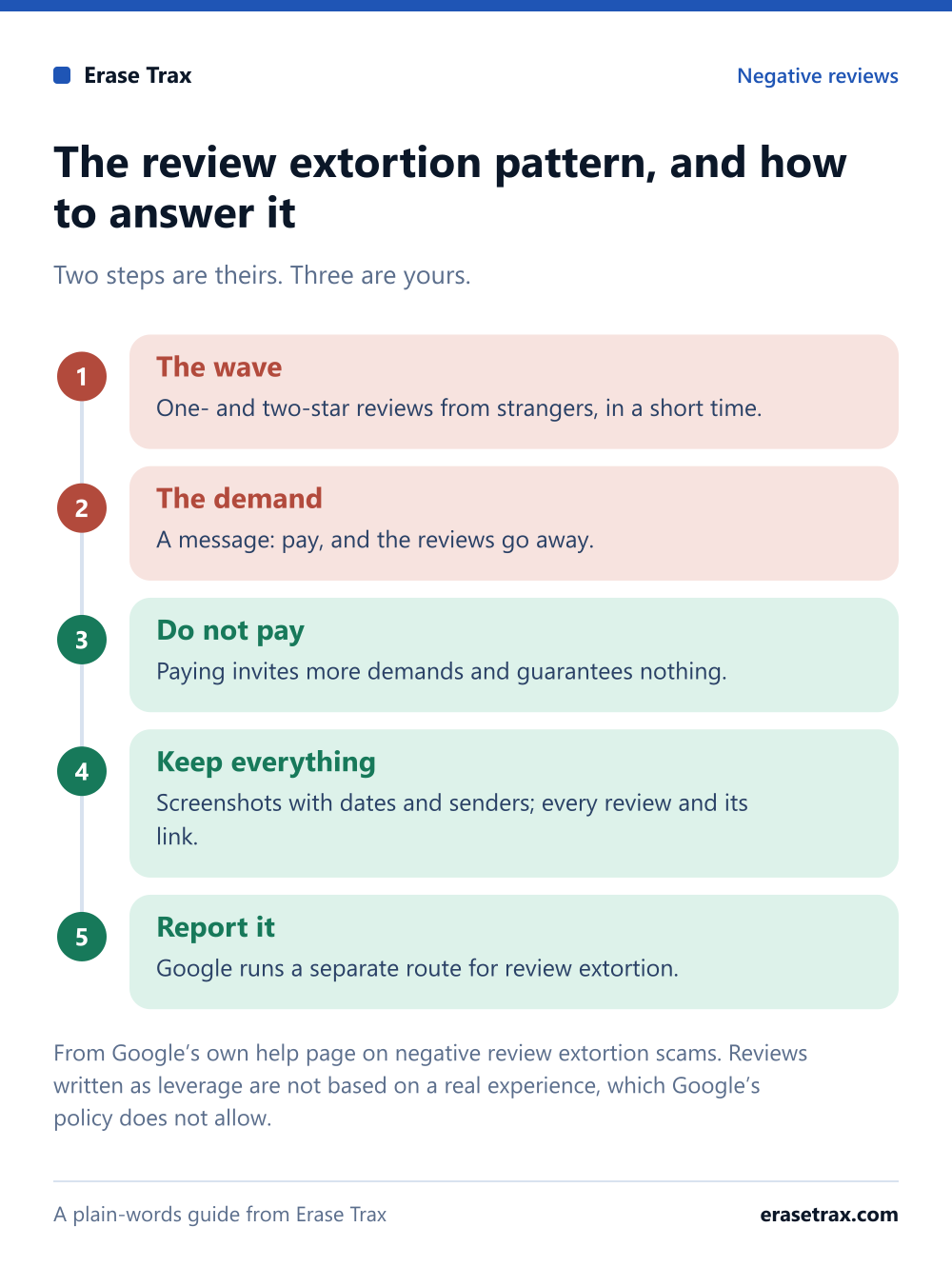
- TheirsThe waveOne- and two-star reviews from strangers, in a short time.
- The demandA message: pay, and the reviews go away.
- YoursDo not payPaying invites more demands and guarantees nothing.
- Keep everythingScreenshots with dates and senders; every review and its link.
- Report itGoogle runs a separate route for review extortion.
From Google’s own help page on negative review extortion scams. Reviews written as leverage are not based on a real experience, which Google’s policy does not allow.
The extortion pattern: two steps are theirs, three are yours.Save the graphic
How to recognize it early
Extortion rarely looks like extortion at first. The first message is often polite, written as an offer of help from a "reputation company" that has "noticed some negative reviews" on your profile. The reviews it mentions may have appeared only hours earlier. Several of the signs below together are a strong warning.
- Bad timingthe offer arrives within hours or days of a run of one-star reviews from strangers.
- Payment firstmoney is wanted before anything happens, often by gift card, cryptocurrency or a transfer that cannot be reversed.
- Certaintythe sender promises the reviews will disappear, which no honest firm can promise, because the platform decides.
- Pressurea deadline, and a warning that more reviews will follow if you do not act.
A legitimate firm never creates the problem it offers to solve, and none can guarantee a removal. If an offer has any two of those signs, treat it as part of the scam and keep it as evidence rather than answering it.
Why you should never pay
- It does not enda business that pays has shown it will pay. The same people, or others they sell your details to, come back.
- Nothing is guaranteedthey cannot promise the reviews will come down, and many simply take the money.
- It weakens your positiona payment is a transaction you may later have to explain. The messages they sent you are evidence; a payment muddies it.
Google’s own advice is the same: do not engage with or pay the people behind it. You can read it in Google’s help page on negative review extortion scams.
What to keep, starting now
Evidence disappears quickly in these cases, because accounts get deleted, messages unsent and reviews edited. Gather it before you do anything else.
- The demand itselfscreenshots that show the date, the time and the sender, not just the text.
- Every follow-uplater messages, changed amounts, new threats. Keep the whole conversation, not only the first message.
- The reviewseach one, with its date and the reviewer’s profile, and a link to it.
- The timelinewhen the reviews started, when the demand came, and anything that happened in between.
How Google treats these reviews
Reviews written as leverage are not based on a real experience, and Google’s policy does not allow content that is not. Because extortion is a recognized pattern, Google also runs a separate route for reporting it, apart from the ordinary report button on a single review, and says it investigates each report it receives. It does not share the details of its investigation, so you may not hear what was found, only see the result.
We do not set out the filing process here, because the platform’s route changes, and a case is stronger when it is prepared once, with the evidence above, by someone who knows what it needs. That preparation is what our Google review removal service handles, and it is only invoiced for removals verified on your live profile.
Should you reply to the reviews?
Reply once, calmly, to the most visible ones, and say nothing about the demand in public. A reply that mentions money, threats or a scam turns your profile into the place where the dispute happens, and real customers reading it do not need the details.
Illustrative: “We have no record of this visit and have reported the review. If you are a customer and something went wrong, please contact us directly and we will put it right.”
Do not reply to the message that made the demand. Silence gives them nothing to work with, and anything you say can be quoted back at you.
When to involve the police or a lawyer
Demanding money with threats is generally treated as extortion or blackmail, a crime, in the United States, the United Kingdom, Canada and Australia. If you are threatened with anything beyond reviews, if the demands escalate, or if you know who is behind it, report it to the police and keep the reference number. If the loss is significant, a solicitor or attorney can advise on what else is open to you. We are not lawyers, and this is not legal advice.
How to make your profile a harder target
Extortion works best on a profile with few reviews, where five new one-star reviews move the average a long way. A profile with a steady flow of genuine, recent reviews is both harder to damage and less attractive to target. Two habits help.
- Watch the profile — so that you see the first fake review, not the tenth. A reputation monitoring service sends each new review as it appears.
- Grow genuine reviews — ask every customer, fairly and at the right moment, without incentives, and within each platform’s policy.
What this comes down to
Review extortion is a scam with a recognizable shape: fake one-star reviews and a demand for money. Do not pay, do not negotiate, keep every message and screenshot every review. Google treats these reviews as violating its policies and has its own route for extortion. If it is happening to you, send us the profile and the messages. The first step is a free check of your reviews.
About this guide
Written by the Erase Trax review team: specialists in review policy, working with businesses in the United States, the United Kingdom, Canada, Australia and the United Arab Emirates. Each guide is written against the platforms’ own published policies. Last reviewed .
- We never need your login
- We never buy, write or incentivize reviews
- The platform makes the final decision