In this article8 sections · 6 min
What review bombing is
Review bombing is a burst of negative reviews in a short time, written because of something other than a customer’s own experience. It can follow a news story, a viral post or a comment by the owner. It can be organized in a forum or a group chat, or it can come from a rival, or from someone who wants money to make it stop.
What the reviews have in common is that most of the people writing them never bought anything from you. This matters because every major platform requires a review to be based on a real experience. Google’s policy, for example, treats content that is not based on a genuine experience as fake engagement.
Telling an attack from a genuinely bad week
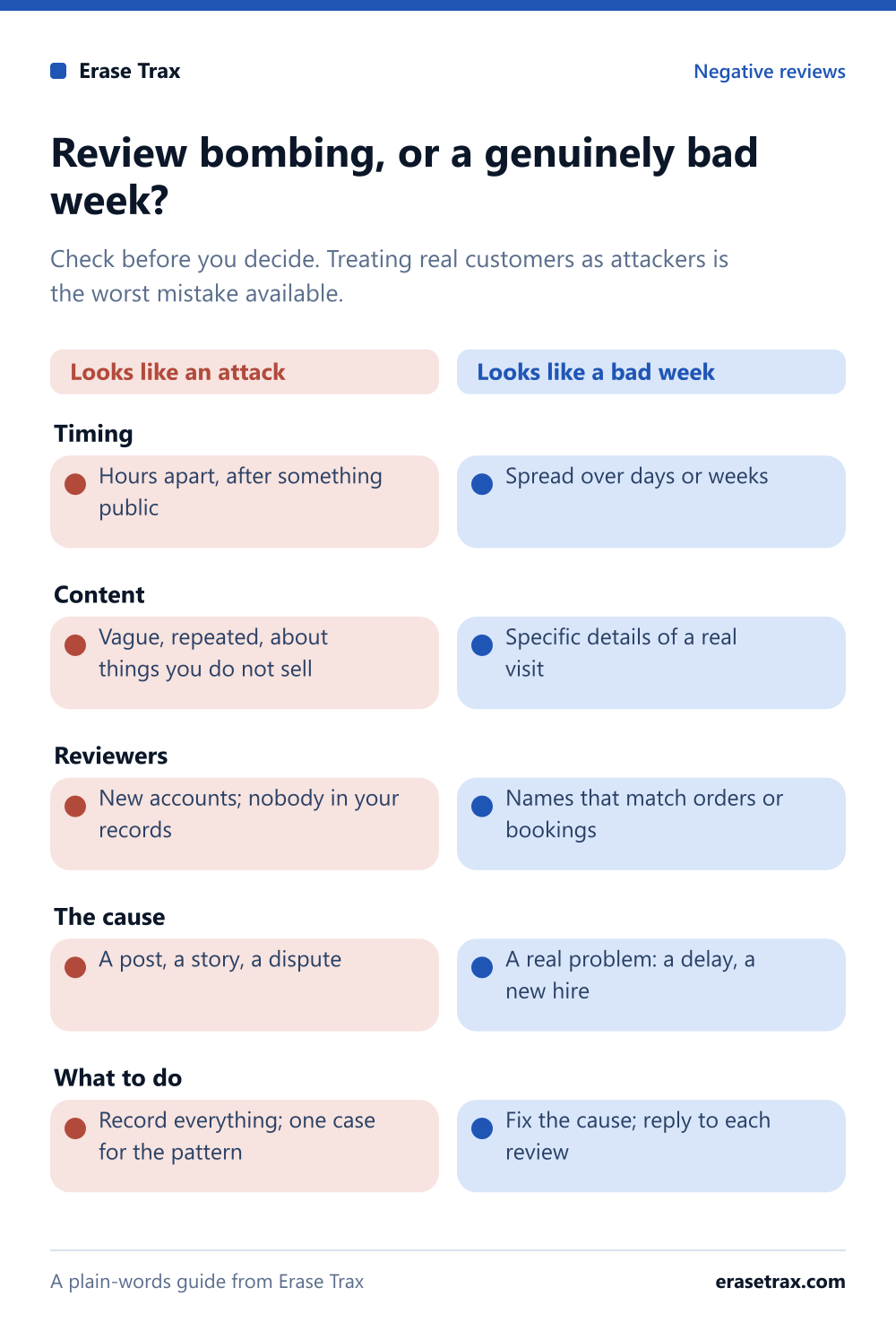
Not every cluster of bad reviews is an attack. A real problem (a supplier failure, a new manager, a botched job that a customer shared online) can produce several honest complaints close together. Treating real customers as attackers is the worst mistake available here, so check before deciding.
- Timingreviews within hours of each other, often after a public event that has nothing to do with a purchase.
- Contentvague, repeated or copied wording, or complaints about something you do not sell.
- Reviewersnew accounts, accounts that review businesses all over the world, or names you cannot match to any order or booking.
- The causea post, a news item or a dispute you can point to, which explains why strangers suddenly care.
If the reviews describe real visits and match real customers, you have a service problem, not an attack, and the answer is to fix it and reply to each one properly. If they do not, you are being review bombed.
- Timing
- Looks like an attackHours apart, after something public
- Looks like a bad weekSpread over days or weeks
- Content
- Looks like an attackVague, repeated, about things you do not sell
- Looks like a bad weekSpecific details of a real visit
- Reviewers
- Looks like an attackNew accounts; nobody in your records
- Looks like a bad weekNames that match orders or bookings
- The cause
- Looks like an attackA post, a story, a dispute
- Looks like a bad weekA real problem: a delay, a new hire
- What to do
- Looks like an attackRecord everything; one case for the pattern
- Looks like a bad weekFix the cause; reply to each review
How to tell an attack from a genuinely bad week, and what to do about each.Save the graphic
The first day: what to do
- Record everything. Screenshot each review with its date and the reviewer’s profile, before anything is edited or deleted. A pattern is easier to show when the whole of it is on file.
- Check your records. For each name, look for a matching order, booking or visit. Write down what you find and what you do not.
- Write down the trigger. If you know what started it (a post, a story, a message), save it with the date.
- Pause, then reply once. One calm, public reply to the most visible reviews is enough for now. A dozen angry replies give the attackers what they came for.
There are also things to avoid. Do not ask staff, friends or family to post positive reviews to balance the rating: that is a conflict of interest, and it hands the platform a reason to look at your profile instead of the attackers. Do not argue with reviewers in public. And do not pay anyone who offers to make the reviews disappear for money. That is a different and well-known scam, covered in Google review extortion: what to do when someone demands payment.
Why one case beats twelve complaints
The instinct is to report every review separately, and to have everyone you know report them too. It feels like action. In practice each report is looked at on its own, a single vague one-star review can look like an unhappy customer, and a flood of reports from your side looks like a business trying to clear criticism.
The same reviews look very different together. Twelve reviews in two hours, from accounts with no history, none of whom appear in your records, after a public argument you can date: that is a pattern, and a pattern is something a platform can act on. Preparing it that way is the work our removal service takes off your hands.
What platforms can do about a surge
Platforms know review bombing happens and have their own ways of dealing with it. Removal is one. Some platforms may also limit new reviews on a profile for a while after an unusual surge, or show a notice to readers that the profile has had unusual activity. Those decisions belong to the platform, and none of them can be ordered, but a clear, single case is what gives the platform something to act on.
Your reply, while the case runs
Customers who look at your profile during an attack see two things: the reviews, and how you responded. A short reply that stays factual reassures them more than silence does and far more than an argument.
Illustrative: “Over the past day this page has received a number of reviews from people we cannot find in our customer records, following a post elsewhere. We have reported them. If you are a customer and we have let you down, please call us directly. We want to hear from you.”
Note what it does not do: it does not accuse anyone by name, it does not call every reviewer a liar, and it leaves the door open to a real customer who may be among them. Our guide on how to respond to negative reviews has more on tone.
After the attack
When it is over, two things are worth doing. Keep watching the profile, because attacks sometimes return in a second wave, and a removed review can occasionally reappear. And rebuild the rating honestly, by asking real customers for reviews at the right moment, with nothing offered in return and within every platform’s policies.
If your business is the kind that attracts pile-ons, such as a restaurant after a viral post or a firm in the news, a reputation monitoring service means you see the first review of a wave, not the twentieth.
What this comes down to
Review bombing is a flood of reviews from people with no real experience of your business, and that violates policy of every major platform. Check first that it really is an attack, record everything, reply once and calmly, and treat the reviews as one pattern rather than many complaints. If it is happening to you now, send us the profile: the free audit of your reviews comes back within 24 hours, and removal is only invoiced once it is verified on your live profile.
About this guide
Written by the Erase Trax review team: specialists in review policy, working with businesses in the United States, the United Kingdom, Canada, Australia and the United Arab Emirates. Each guide is written against the platforms’ own published policies. Last reviewed .
- We never need your login
- We never buy, write or incentivize reviews
- The platform makes the final decision