In this article13 sections · 11 min
- Start by seeing what your customers see
- Sort the list into four piles
- Fix the real problem first
- Answer every genuine review, calmly, in public
- Have the policy-violating content removed
- Push down what cannot be removed
- When the problem is your own name
- Do not forget the AI assistants
- Rebuild with genuine reviews
- Keep it fixed
- How long does it take?
- The mistakes that make a bad reputation worse
- Your plan on one page
Start by seeing what your customers see
You cannot fix what you have not looked at properly, and most owners have never looked at their own business the way a stranger does. So do that first, and do it carefully. Open a private browser window, so your own history does not change the results, and search for your business name. Then search for your name with your town, with the word “reviews”, and with the word “complaints”. If you are the face of the business, search your own name too.
Look at the whole first page of results, not just the top one. Look at the map and your Business Profile, and the star rating beside it. Open the review sites that come up: Google, plus whichever matter in your trade, such as Trustpilot, Yelp, Facebook, TripAdvisor or Glassdoor. Then, because more customers now ask assistants instead of searching, ask ChatGPT or Gemini what it knows about your business and whether it would recommend it.
Write every negative thing down in a simple list: where it is, what it says, how old it is, and how prominent it is. A one-star review on page five of a review site matters much less than a complaint thread that sits third in Google for your name. By the end you will have an honest map of the problem, which is more than most owners ever have.
Sort the list into four piles
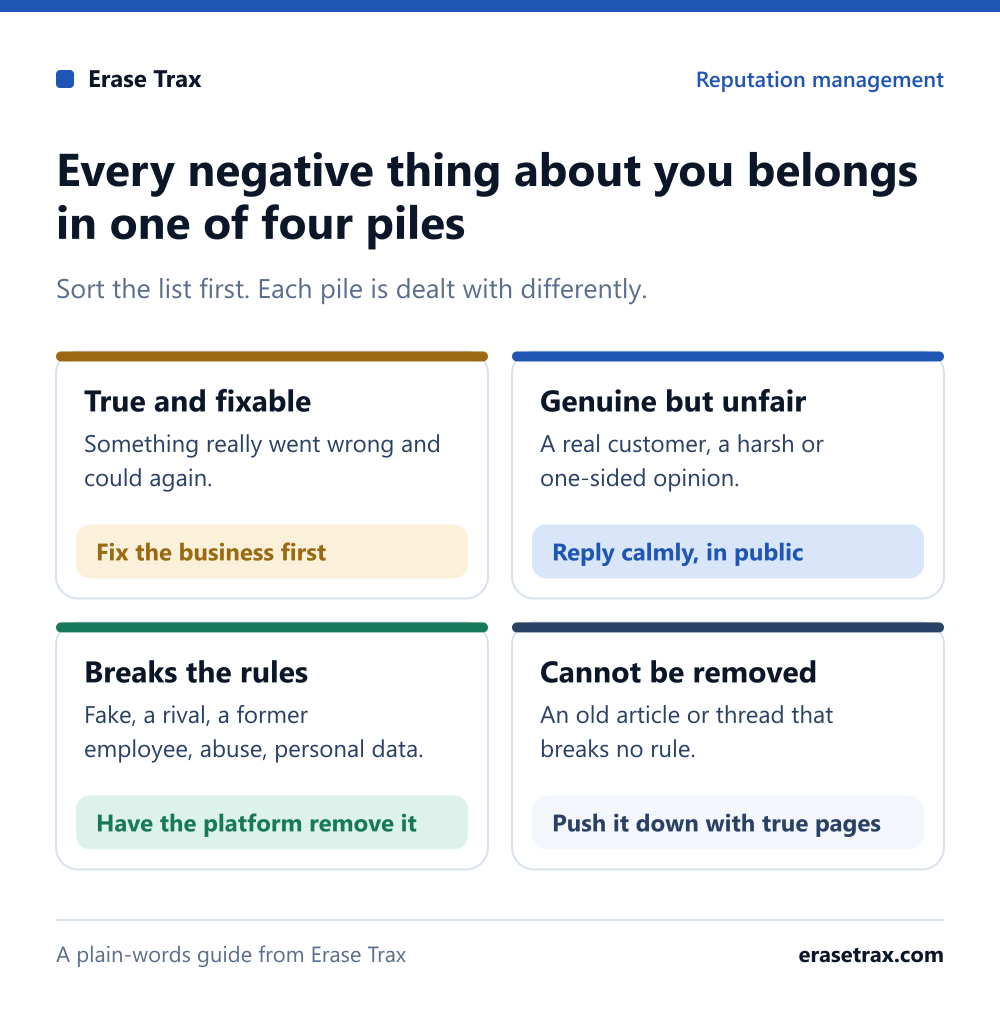
Every item on your list belongs in one of four piles, and each pile is dealt with differently. Sorting them is the most valuable hour you will spend on this.
- True and fixableSomething really went wrong and could again. Fix the business first
- Genuine but unfairA real customer, a harsh or one-sided opinion. Reply calmly, in public
- Breaks the rulesFake, a rival, a former employee, abuse, personal data. Have the platform remove it
- Cannot be removedAn old article or thread that breaks no rule. Push it down with true pages
The four piles, and what to do with each.Save the graphic
Picture an invented example. You run a dental practice. Your list has twelve items: seven Google reviews, one forum thread from years ago about a billing dispute, two Facebook comments, a complaint-site page, and a lukewarm answer from an AI assistant that mentions the billing story. Sorted, three reviews describe a real problem with waiting times, two are unfair but genuine, two are from people who were never patients, the forum thread and the complaint page violate no policies, and the AI answer is repeating the thread. Once it is sorted like that, you can see the shape of the problem and plan around it.
Fix the real problem first
This is the step that reputation companies are often too polite to mention, and it matters more than anything else in this guide. If several customers are saying the same true thing, no amount of review removal or search work will hold. New reviews will keep arriving with the same complaint, and every one will undo the work.
So before you spend a penny on your reputation, look at the true-and-fixable pile and change whatever caused it. In the invented dental example, that means sorting out appointment times rather than hiding the reviews about them. Then reply to those reviews and say what has changed. A reader who sees a complaint followed by an honest answer, such as “you were right, here is what we did about it”, often trusts the business more than one with no complaints at all.
Answer every genuine review, calmly, in public
The genuine-but-unfair pile is where owners lose the most ground, usually by arguing. You will not win an argument on a review page, but you can win the reader, and the reader is the only person who matters there.
A good reply is short and specific. It thanks the reviewer, acknowledges the experience without accepting everything in it, says what you did or will do, and offers a direct way to talk. It never reveals anything about the customer, never accuses anyone of lying, and never threatens. If you write one reply a day, a profile that has gone unanswered for a year can look cared for within a few weeks. We go through wording in detail in our guide to replying to negative reviews.
Have the policy-violating content removed
The third pile is the most satisfying to deal with, because these items can actually go. Every major platform has published policies, and reviews and posts that break them can be removed by the platform: reviews from people who were never customers, from competitors or former staff, reviews meant for another business, abuse, hate, threats, and personal information about your team.
A review that is merely unfair stays up: platforms keep opinions, even harsh ones. What a platform removes is content that breaks its published policies, and only that. Our online reputation management work starts here, and our review removal service handles it on Google, Trustpilot, Facebook, Reddit and Instagram. You are only invoiced once a removal is verified on your live profile, so a review that stays up costs you nothing.
Be wary of anyone who promises to remove everything on your list, or quotes a success rate. The platform decides, and a firm that promises otherwise is either guessing or planning something that will hurt you later, such as posting reviews rather than removing them. We explain what to ask any provider in how to choose a review removal company.
Push down what cannot be removed
The fourth pile is the hardest: the old article, the forum thread, the complaint page that violates no policy. These are not going to be deleted. What can change is where they appear. Most people never look past the first page of results for a business name, and many never scroll past the first few results. A negative page that moves from third to second page has, for most searchers, stopped existing.
Pushing a page down means giving search engines better, true pages about you to rank above it: your own website’s pages, your profiles on the platforms that matter in your trade, genuine articles about your work, interviews, directories that rank well. This is slow work measured in months, and some strong results never fully move, which anyone honest will tell you at the start. It is what our service to push down negative search results does, and the thinking behind it is set out in what is search engine reputation management?.
When the problem is your own name
In a small business the owner and the business are often the same thing in a customer’s mind, and sometimes the negative result is about you rather than the company: an old dispute, a court listing, a post someone wrote about you personally. The same four piles apply. If it violates a platform’s policies or the law (personal information, harassment or impersonation, for instance), it may be removable. If it does not, it can be outranked.
Outranking a personal name usually starts with pages that belong to you and are clearly about you: a short, accurate biography on your business website, professional profiles you keep up to date, and anything genuine you have written, said or been recognized for. Keep everything consistent, so search engines can tell which person they are looking at. And be patient: a personal name with little else published about it can move sooner than a busy business name, but nothing about search is instant.
Do not forget the AI assistants
A growing number of customers never see your search results at all. They ask ChatGPT, Gemini or Google’s AI answer which business to use, and they act on what it says. Those assistants build their answers from what is published about you: your website, your reviews, your profiles, articles and forum threads. If the most detailed thing written about your business is an old complaint, that is what an assistant will lean on.
The fix is the same in spirit as pushing down search results: make sure the clearest, most current, most complete information about your business is true and published where assistants read. A website that plainly says what you do, where and for whom, with real answers to common questions; profiles that agree with it; and a steady flow of recent reviews. That is what SEO & AI search works on.
Rebuild with genuine reviews
Removal and suppression clear the ground. What grows on it is up to you, and the single most effective thing you can do is ask every customer for an honest review. Ask all of them, not only the ones you know were delighted, and never in exchange for anything: asking selectively and rewarding reviews violate the platforms’ policies, and both tend to come back on you when the reviews are later removed.
Ask at the moment the customer is most pleased: the job finished, the keys handed over, the treatment done. Make it easy, with one link straight to the review form. Do it every week, not in a campaign once a year. After a few months a profile that was defined by a handful of bad reviews is defined by dozens of recent good ones, and the bad ones shrink to what they always should have been, a small part of a much bigger picture. Nothing about it needs outside help, only the habit of asking.
Keep it fixed
A repaired reputation does not stay repaired on its own. New reviews arrive every week, new pages get published, and the one review that matters most is always the one you have not seen yet. The owners who keep a good reputation are the ones who see every new review the day it arrives, reply within a day, and notice a pattern before it becomes a problem.
You can do that yourself with a weekly hour and a list of the platforms that matter to you. If you do not have the hour, a reputation monitoring service does it for you, sends each new review as it lands, and flags the ones that break a platform’s policies straight away.
It also helps to agree, inside the business, who owns this. In many small firms reviews are everybody’s job and therefore nobody’s: the owner assumes the office manager is replying, the office manager assumes the owner prefers to. Name one person and give them the list of platforms and a simple routine: every review answered within a day, and anything that looks like it violates policy passed on the same day. With that in place, the reputation you have rebuilt will stay rebuilt.
How long does it take?
Each part moves at its own pace. Replying to reviews changes how your profile reads straight away. Removals are decided by the platforms in their own time. Pushing down a search result takes months, and a strong result on a high-authority site can take much longer. A healthy flow of new reviews takes a few months to change the shape of a profile. Anyone who promises the whole job in a fixed number of weeks is guessing. We go into this in how long does online reputation management take to work?.
The mistakes that make a bad reputation worse
- Buying reviews, or asking staff, friends and family to post them. It is against every platform’s policies, now against the law in the US and the UK, and the reviews tend to be removed, taking your rating with them. See are fake reviews illegal?.
- Threatening reviewers or the sites that host them. It rarely removes anything and often turns a quiet complaint into a public story.
- Arguing in replies. Every argument is read by every future customer.
- Hiring anyone who promises guaranteed removals or page-one rankings. Nobody controls the platforms or Google.
- Fixing the reviews and not the business. If the cause is still there, the reviews will come back.
Your plan on one page
- Search yourself like a stranger, and ask an AI assistant about your business. List everything negative.
- Sort the list: true and fixable, genuine but unfair, violates policy, cannot be removed.
- Fix the real problems in the business first.
- Reply calmly and publicly to every genuine review.
- Have policy-violating reviews and posts removed by the platforms.
- Push down what cannot be removed with better, true pages about you.
- Make sure your website and profiles give AI assistants a clear, current, true picture.
- Ask every customer for an honest review, every week, with nothing offered.
- Watch every platform that matters and reply within a day.
If you would like a second pair of eyes on your list, send us your business name. The free audit comes back within 24 hours and tells you which items can be removed, which can only be answered or pushed down, and what each would take, with no obligation either way.
About this guide
Written by the Erase Trax review team: specialists in review policy, working with businesses in the United States, the United Kingdom, Canada, Australia and the United Arab Emirates. Each guide is written against the platforms’ own published policies. Last reviewed .
- We never need your login
- We never buy, write or incentivize reviews
- The platform makes the final decision