In this article9 sections · 7 min
- Are fake reviews illegal in the United States?
- Are fake reviews illegal in the United Kingdom?
- Are fake reviews illegal in Canada?
- Are fake reviews illegal in Australia?
- Who is breaking the law: the business, the reviewer or the platform?
- Is the business liable if an agency or employee posted the fake reviews?
- Is it legal to ask customers for reviews?
- Is it legal to pay someone to remove fake reviews?
- What should a business do now?
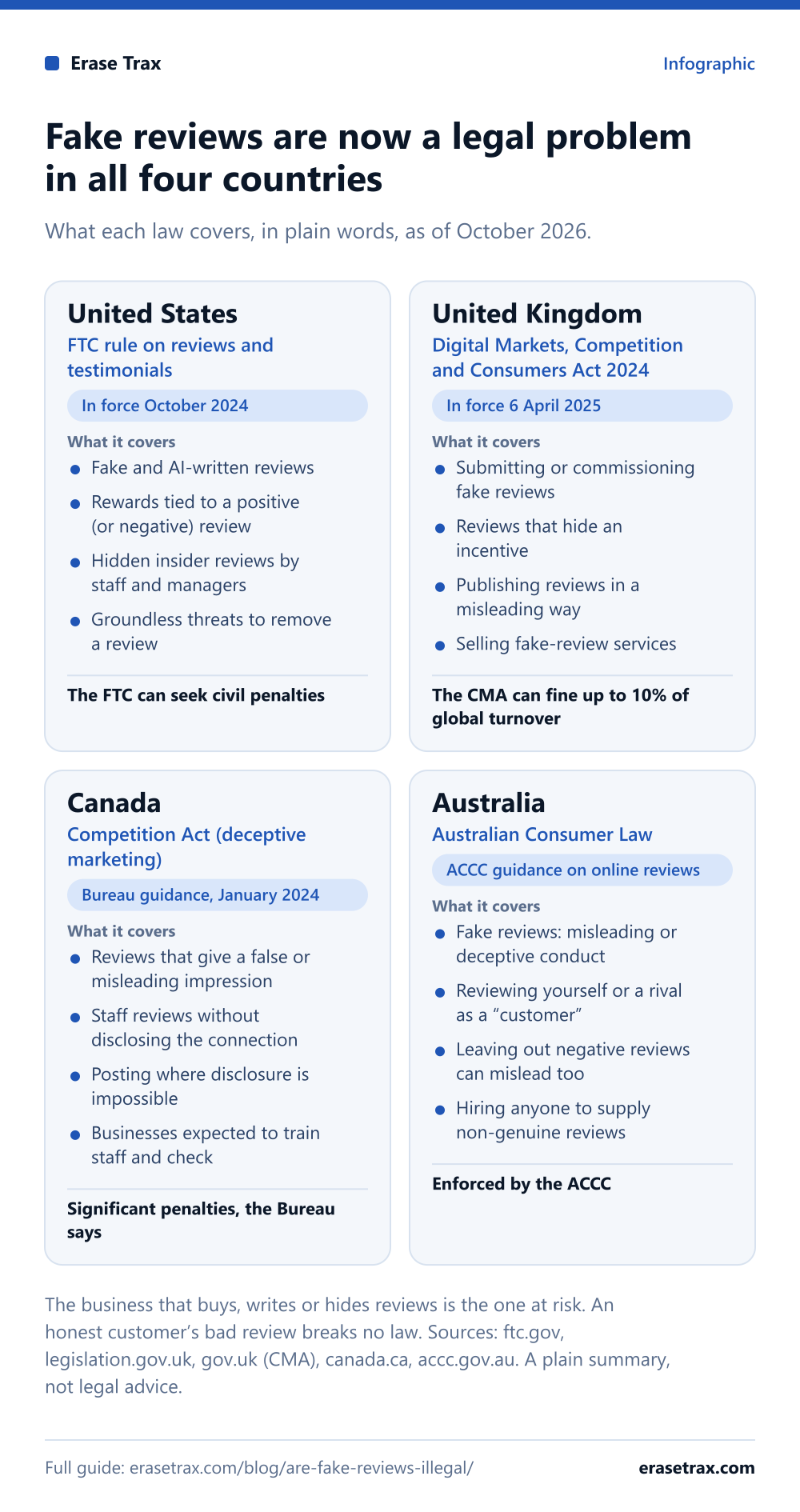
- Fake and AI-written reviews
- Rewards tied to a positive (or negative) review
- Hidden insider reviews by staff and managers
- Groundless threats to remove a review
The FTC can seek civil penalties
- Submitting or commissioning fake reviews
- Reviews that hide an incentive
- Publishing reviews in a misleading way
- Selling fake-review services
The CMA can fine up to 10% of global turnover
- Reviews that give a false or misleading impression
- Staff reviews without disclosing the connection
- Posting where disclosure is impossible
- Businesses expected to train staff and check
Significant penalties, the Bureau says
- Fake reviews: misleading or deceptive conduct
- Reviewing yourself or a rival as a “customer”
- Leaving out negative reviews can mislead too
- Hiring anyone to supply non-genuine reviews
Enforced by the ACCC
The business that buys, writes or hides reviews is the one at risk. An honest customer’s bad review breaks no law. Sources: ftc.gov, legislation.gov.uk, gov.uk (CMA), canada.ca, accc.gov.au. A plain summary, not legal advice.
Infographic: what the fake review laws ban in the US, the UK, Canada and Australia. Free to share with a link to this page.Save the graphic
This page is a plain summary of what the regulators have published, with links to each source. It is not legal advice; for your own situation, speak to a solicitor or attorney in your country.
Are fake reviews illegal in the United States?
Yes. The Federal Trade Commission’s rule on consumer reviews and testimonials, announced on 14 August 2024, bans fake and false reviews outright and took effect in October 2024. The FTC can seek civil penalties from businesses that break it. The rule was published in the Federal Register on 22 August 2024 and took effect 60 days later. It is codified as 16 CFR Part 465, the Rule on the Use of Consumer Reviews and Testimonials, and the FTC’s own summary is in its announcement of the final rule.
What does the FTC rule ban?
- Fake or false reviewsreviews by people who do not exist (including AI-generated ones), by people with no real experience of the business, or that misrepresent the reviewer’s experience. Creating, selling or buying them is banned.
- Buying reviews of a set sentimentpaying or rewarding people on condition that the review is positive (or, about a rival, negative).
- Undisclosed insider reviewsreviews by officers, managers or staff that hide their connection to the business.
- Fake “independent” review sitesa site the business controls, presented as independent.
- Review suppressiongroundless legal threats, intimidation or false accusations used to stop or remove a negative review, and hiding negative reviews while implying the reviews shown are all of them.
- Fake social influencebuying or selling fake followers or views for a commercial purpose.
The rule protects the reviewer as well, which matters to any business owner with a bad review on their profile. Threatening a customer with groundless legal action to make them take a review down is itself a breach.
Are fake reviews illegal in the United Kingdom?
Yes. The Digital Markets, Competition and Consumers Act 2024 added fake reviews to the list of practices that are always unfair, from 6 April 2025. Schedule 20 of the Act bans submitting or commissioning a fake review, or a review that hides the fact it was incentivized; publishing reviews in a misleading way; and offering services to businesses to do either.
Businesses that publish reviews must also take reasonable and proportionate steps to stop fake ones appearing and to remove them. The Competition and Markets Authority explains what that means in its fake reviews guidance (CMA208), and under the same Act it can now fine a business directly, up to 10% of its global turnover, without going to court first.
Are fake reviews illegal in Canada?
Yes, as misleading advertising. Canada has no review-specific statute, but the Competition Bureau has said plainly that anyone who writes, or allows to be written, reviews that give a false or misleading impression may be liable under the Competition Act, and that the penalties can be significant.
The Bureau has been specific about staff. Employees who review their employer, or its competitors, must disclose the connection even when their opinion is honest, and where that disclosure cannot be shown clearly (a bare star rating, for example), they should not post at all. Businesses are expected to train staff and check. See the Bureau’s release, online reviews posted by employees: businesses could be liable.
Are fake reviews illegal in Australia?
Yes, as misleading or deceptive conduct under the Australian Consumer Law. The Australian Competition and Consumer Commission’s position is that a business posting reviews about itself or a competitor, presented as coming from impartial customers, breaks the law. Its guidance also says that leaving out negative reviews can mislead customers just as posting fake ones does, and that hiring anyone to supply reviews from people who are not genuine customers is off limits. The ACCC’s current business guidance on online reviews puts it simply: it is against the law for a business to create fake or misleading reviews, or to arrange for others to do so. Its original guidance about online product reviews sets out the same position.
Who is breaking the law: the business, the reviewer or the platform?
Mainly the business that benefits. All four regimes aim at the trader who buys, writes, commissions or hides reviews, and the UK and US rules also reach the people who sell fake reviews as a service. In the UK, the sites that publish reviews have a duty of their own to prevent and remove fake ones.
An ordinary customer who writes an honest bad review breaks no law, however harsh it is. A rival who posts fake one-star reviews about you is on the wrong side of the platform’s policies and, depending on the facts and the country, may be on the wrong side of consumer or defamation law too. Whether they are is a question for a lawyer, not for a blog post.
Is the business liable if an agency or employee posted the fake reviews?
It can be. The FTC rule covers businesses that buy or procure fake reviews, not only the people who write them, and the Competition Bureau has warned that businesses could be liable for misleading reviews their employees post. Hiring a marketing agency does not move the responsibility away from the business that benefits.
Is it legal to ask customers for reviews?
Yes, in all four countries, as long as you do not pay or reward people for a particular rating, do not hide any incentive you did offer, and do not pick only the customers you expect to be happy. The platforms set stricter policies of their own on top of the law; we set them side by side in can businesses offer incentives for reviews?.
Is it legal to pay someone to remove fake reviews?
Yes. Asking a platform to apply its own policies to a review that violates them is lawful, and so is paying a firm to prepare that case. What is not lawful is paying anyone to post reviews, or using threats to make a reviewer take a genuine review down. That is the line our Google review removal service works on the right side of: we only pursue reviews that violate the platform’s published policies, and we never create, buy or post reviews of any kind.
What should a business do now?
- Stop anything that looks like buying reviews: discounts for five stars, staff reviewing their own employer, friends and family posting.
- Ask every customer fairly, and disclose any incentive clearly if you ever offer one where the platform allows it.
- Do not hide or filter negative reviews on your own website while implying the rest are all of them.
- Answer genuine criticism in public, and challenge only reviews that violate a policy, never with threats.
If you think fake reviews are being posted about you, the free review audit sorts your profile into what violates the platform’s policies and what does not.
Sources
- Federal Trade Commission announces final rule banning fake reviews and testimonialsUS Federal Trade Commission
- Digital Markets, Competition and Consumers Act 2024, Schedule 20legislation.gov.uk
- Fake reviews guidance (CMA208)UK Competition and Markets Authority
- Online reviews posted by employees: businesses could be liableCompetition Bureau Canada
- Online reviews for product and servicesAustralian Competition and Consumer Commission
- ACCC releases guidance about online product reviewsAustralian Competition and Consumer Commission
The policies and laws above are the platforms’ and regulators’ own pages. This article explains them in plain words; it is not legal advice.
About this guide
Written by the Erase Trax review team: specialists in review policy, working with businesses in the United States, the United Kingdom, Canada, Australia and the United Arab Emirates. Each guide is written against the platforms’ own published policies. Last reviewed .
- We never need your login
- We never buy, write or incentivize reviews
- The platform makes the final decision