In this article9 sections · 8 min
- What is the CMA fake review ban?
- What does the DMCC Act actually ban?
- What counts as a fake review under the DMCC Act?
- What must businesses do under the DMCC Act?
- What must platforms and review sites do?
- What should you do if a competitor breaches the DMCC Act?
- Does the DMCC Act stop customers leaving bad reviews?
- How does the UK law compare with other countries?
- Is this legal advice?
What is the CMA fake review ban?
It is the name most people use for paragraph 13 of Schedule 20 to the Digital Markets, Competition and Consumers Act 2024. Schedule 20 is the list of commercial practices that are treated as unfair in all circumstances. A business does not get to argue that a fake review made no difference to anyone’s decision: if the practice is on the list, it is banned.
The paragraph came into force on 6 April 2025. The Competition and Markets Authority, which enforces it, published its fake reviews guidance (CMA208) two days earlier, on 4 April 2025, together with a short guide for businesses that publish reviews. The guidance is the best plain account of how the regulator reads the law, and it is worth reading in full if reviews matter to your business.
What does the DMCC Act actually ban?
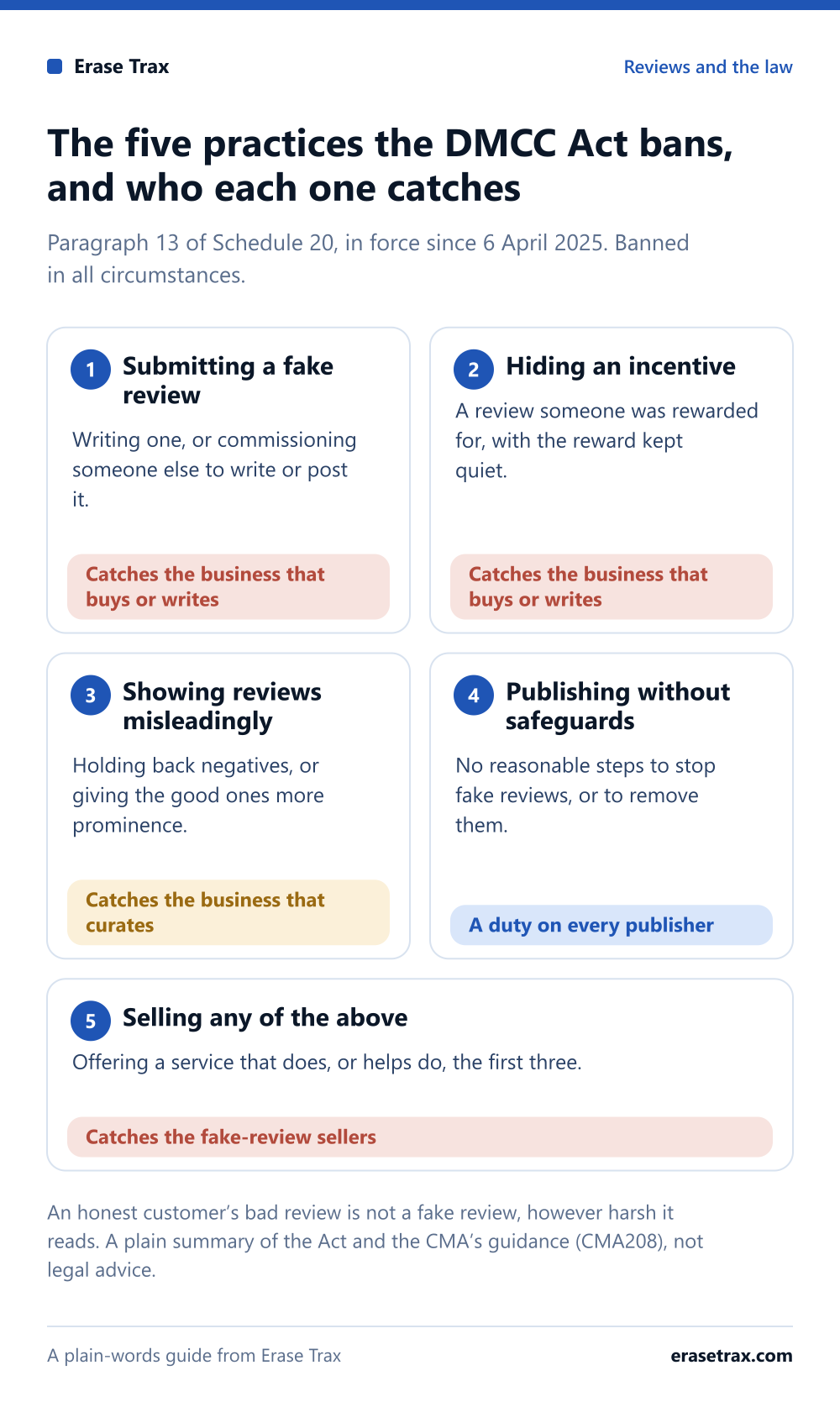
Paragraph 13 lists five practices. In plain English, with who each one is aimed at:
- Submitting a fake reviewWriting one, or commissioning someone else to write or post it.Catches the business that buys or writes
- Hiding an incentiveA review someone was rewarded for, with the reward kept quiet.Catches the business that buys or writes
- Showing reviews misleadinglyHolding back negatives, or giving the good ones more prominence.Catches the business that curates
- Publishing without safeguardsNo reasonable steps to stop fake reviews, or to remove them.A duty on every publisher
- Selling any of the aboveOffering a service that does, or helps do, the first three.Catches the fake-review sellers
An honest customer’s bad review is not a fake review, however harsh it reads. A plain summary of the Act and the CMA’s guidance (CMA208), not legal advice.
Schedule 20, paragraph 13, in plain words.Save the graphic
What counts as a fake review under the DMCC Act?
The Act defines a fake consumer review as one that claims to be based on a person’s genuine experience but is not. That covers a review by someone who never used the business, a review by a person who does not exist, and a review that misdescribes what really happened. The Act says “writing” includes creating by any means, so a review generated by AI and presented as a customer’s experience is caught in the same way as one typed by a person.
A “consumer review” is drawn widely too. It is a review of a product, of a trader, or of anything else relevant to a customer’s decision, so the ban is not limited to stars on Google. It reaches reviews on your own website, on marketplaces, on comparison sites and on social media.
What is a concealed incentivised review?
A review conceals an incentive if someone was commissioned to write it and that fact is not made clear. The Act says commissioning includes incentivising by any means, so it is not only cash. A discount, a free product, entry to a prize draw or any other reward can count. The test is whether the reader can see that the reviewer was rewarded.
The law and the platforms are not the same thing here. The Act bans hiding an incentive; many platforms go further and ban offering one at all. Google’s prohibited and restricted content policy, for example, does not allow businesses to offer payment, discounts or free goods in exchange for reviews. We set the law and the main platforms’ policies side by side in can businesses offer incentives for reviews?.
What does publishing reviews in a misleading way mean?
The Act gives examples. Holding back or removing negative reviews while showing positive ones (or the reverse). Giving positive reviews more prominence than negative ones (or the reverse). Leaving out information that matters to how a review came to be written, such as the fact that the reviewer was paid. A “reviews” page that quietly shows only the five-star ones is the plainest case.
What must businesses do under the DMCC Act?
Every business that asks for, uses or shows reviews has the same basic obligations. In practice that means:
- Never write, buy or commission reviews of your own business, and never post reviews about a competitor.
- Do not reward reviews in secret. If an incentive is ever offered where the platform’s policy allows it, the reward must be made clear.
- Ask customers fairly, without picking only those you expect to be happy.
- Show reviews honestly on your own website: no hidden negatives, no promoting the good ones above the rest without saying so.
- Do not let staff, friends or family post reviews that look like ordinary customer reviews.
- Do not hire any agency or freelancer that offers to “boost” ratings with reviews from people who are not real customers.
The last point matters because the ban works in both directions. A business that commissions fake reviews breaks the law, and so does the firm that sells them. Paying someone else to do it does not move the risk away from you.
What must platforms and review sites do?
Anyone who publishes consumer reviews must take reasonable and proportionate steps to prevent fake reviews, concealed incentivised reviews and false or misleading review information from appearing, and to remove them. The duty is not limited to the big platforms. A business that publishes reviews on its own site carries a version of it too, scaled to its size and risk.
The CMA’s guidance sets out what reasonable steps can look like, starting with a published policy that clearly prohibits fake reviews and states the publisher’s approach to incentivised reviews, an assessment of the risks, and processes to detect, investigate and remove banned reviews. It does not prescribe a single checklist; what counts as proportionate depends on the publisher. The detail is in the CMA’s fake reviews guidance, and that document, not a summary of it, is what a compliance review should start from.
For a business owner the practical effect is helpful. Platforms operating in the UK have a legal reason, not just a policy reason, to act on credible reports of fake reviews, and a well-evidenced report is easier for them to act on.
What should you do if a competitor breaches the DMCC Act?
If you believe a rival is posting fake reviews about you, or buying fake reviews for itself, the most effective route is usually the platform first, then the regulator, with legal advice where the harm is serious.
- Record the evidence: screenshots with dates, reviewer profile names, timing patterns, and anything that links the reviews to the competitor. Do not reply with accusations in public.
- Report each review through the platform’s own channel, citing the specific policy it violates (for example, a conflict of interest or content not based on a real experience). Platforms decide on their policies, not on the Act, so frame the report that way.
- If the conduct is wider than a few reviews, such as a rival selling or buying reviews at scale, you can report it to the CMA, which enforces the ban.
- Where the reviews make false statements of fact that harm your business, speak to a solicitor about whether defamation or another claim may apply.
We cover the platform side of this in more detail in how to deal with a competitor posting fake reviews. If you would rather have help, the free review audit sorts your profile into reviews that violate the platform’s policies and those that do not. We work through the platforms’ official channels, never need your login, and you pay only after a removal is verified. The platform always makes the final decision, so nobody can honestly promise a result.
Does the DMCC Act stop customers leaving bad reviews?
No. A genuine customer writing an honest negative review about a real experience is not a fake review, however harsh it reads. The Act protects that review: hiding or removing genuine negative reviews while keeping the positive ones is itself a form of misleading publication. A one-star review is only a problem under the Act if it is not based on a genuine experience, or if someone was secretly rewarded for it.
How does the UK law compare with other countries?
The UK is one of several markets where fake reviews are now a legal matter. The United States, Canada and Australia each deal with them under their own consumer law, through their own regulators. We compare all four in are fake reviews illegal?, and our UK reputation management page explains how we work for British businesses.
Is this legal advice?
No. This is a plain-English summary of the Act and the CMA’s published guidance, with links to both so you can read them yourself. It does not cover every detail or exception, and the law may change. For advice on your own situation, speak to a solicitor who practises consumer law.
Sources
- Maps user-generated content policy: prohibited and restricted contentGoogle
- Digital Markets, Competition and Consumers Act 2024, Schedule 20, paragraph 13legislation.gov.uk
- Fake reviews guidance (CMA208)UK Competition and Markets Authority
- Short guide for businesses: publishing consumer reviews and complying with consumer protection lawUK Competition and Markets Authority
The policies and laws above are the platforms’ and regulators’ own pages. This article explains them in plain words; it is not legal advice.
About this guide
Written by the Erase Trax review team: specialists in review policy, working with businesses in the United States, the United Kingdom, Canada, Australia and the United Arab Emirates. Each guide is written against the platforms’ own published policies. Last reviewed .
- We never need your login
- We never buy, write or incentivize reviews
- The platform makes the final decision