In this article9 sections · 6 min
- What does Google say about incentives for reviews?
- What does Yelp say about asking for reviews?
- What does Trustpilot say about review invitations?
- What does the law say about review incentives?
- What counts as an incentive?
- Can you thank customers who leave a review?
- What about loyalty programs and review apps?
- What happens if a business violates these policies?
- How do you get more reviews without incentives?
What does Google say about incentives for reviews?
Google does not allow them. Its policy on prohibited and restricted content says merchants may not offer incentives (payment, discounts, free goods or services) in exchange for a review, for changing a review, or for removing a negative one. Incentivized reviews are treated as rating manipulation and removed.
Is review gating allowed on Google?
No. “Review gating” means checking how a customer feels first and sending only the happy ones to Google. Google’s policy says merchants may not discourage or prohibit negative reviews or selectively solicit positive ones. It also forbids pressuring customers to review while they are on the premises, setting review quotas for staff, and asking for specific content in the review.
So what is allowed on Google?
Asking is allowed. Google’s policy lets a business request genuine reviews from its customers, as long as it offers nothing for them and does not try to influence the rating or the content. In practice that means sending every customer the same request, with no reward attached.
What does Yelp say about asking for reviews?
Yelp goes further than anyone: it asks businesses not to ask at all. Its support page, Don’t Ask for Reviews, says not to ask customers, mailing list subscribers, friends or family for reviews, that staff should never compete to collect them, and that freebies, discounts or payment in exchange for reviews are off limits and may also be illegal. The same goes for incentives to remove a review.
Yelp explains why: its recommendation software tries to spot reviews that seem prompted by the business and may not recommend them, and where it learns that a business is rewarding reviews it can place a Consumer Alert on the page. We cover how that filter works in Yelp review removal, and why Yelp is different.
What does Trustpilot say about review invitations?
Trustpilot encourages businesses to invite reviews, on its terms. Its guidelines for businesses say invitations must be fair, neutral and unbiased with no incentives offered, and that a business must not be selective (inviting only people it knows had a good experience, timing invitations so only happy customers reach them, or pre-screening who is sent to review). Misuse can lead to account action or a Consumer Warning on the profile.
Press a platform to light its column.
| What a business might do | |||
|---|---|---|---|
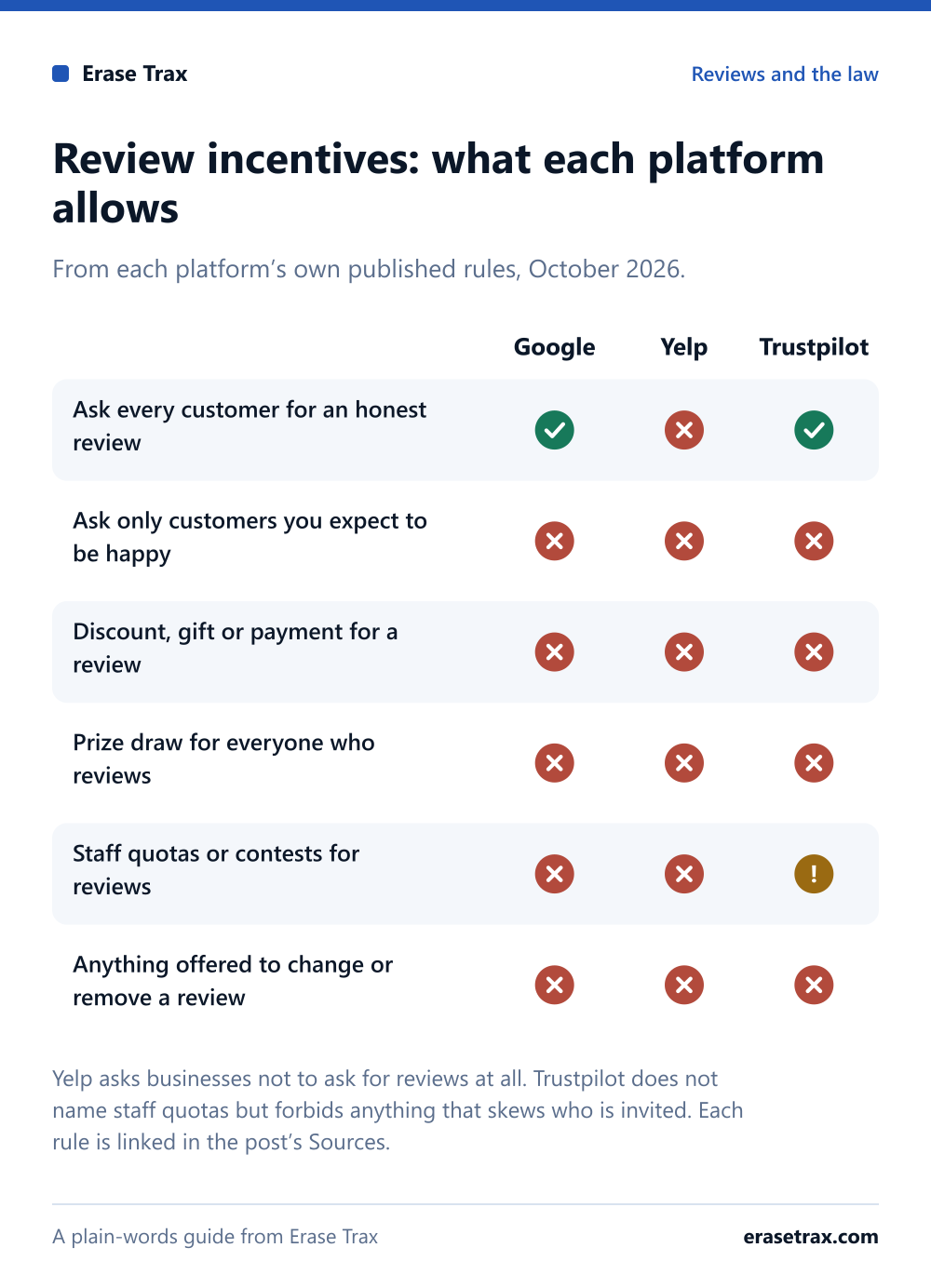
| Ask every customer for an honest review | Allowed | Not allowed | Allowed |
| Ask only customers you expect to be happy | Not allowed | Not allowed | Not allowed |
| Discount, gift or payment for a review | Not allowed | Not allowed | Not allowed |
| Prize draw for everyone who reviews | Not allowed | Not allowed | Not allowed |
| Staff quotas or contests for reviews | Not allowed | Not allowed | Not named, but limited |
| Anything offered to change or remove a review | Not allowed | Not allowed | Not allowed |
- Allowed
- Not allowed
- Not named, but limited
Yelp asks businesses not to ask for reviews at all. Trustpilot does not name staff quotas but forbids anything that skews who is invited. Each rule is linked in the post’s Sources.
What Google, Yelp and Trustpilot allow, from each platform’s own published policies.Save the graphic
What does the law say about review incentives?
The law draws a narrower line than the platforms, but it is a hard one. In the United States, the FTC’s rule bans giving compensation or other incentives on condition that the review expresses a particular sentiment (positive about you, or negative about a competitor), whether that condition is stated or merely implied. In the United Kingdom, the Digital Markets, Competition and Consumers Act 2024 bans a review that conceals the fact it was incentivized.
So a reward that depends on the rating is unlawful in the US, and a hidden reward is unlawful in the UK. The platforms then forbid rewards altogether. In practice the platform policy is the one that decides, because it is the stricter of the two. Our guide are fake reviews illegal? sets out the law in all four countries.
What counts as an incentive?
- Money and discountscash, vouchers, money off the next order, refunds offered for a review.
- Free thingsa free coffee, dessert, upgrade, service or sample in return for posting.
- Prize drawsentry into a competition for everyone who leaves a review.
- Staff rewardsbonuses, league tables or quotas for employees who collect reviews.
- Reverse incentivesanything offered to a customer to change or delete a negative review.
Can you thank customers who leave a review?
A thank-you reply under the review is always fine, and it is good practice. What turns a thank-you into an incentive is a reward that customers expect in advance: a discount that "everyone who reviews us" receives is an incentive, whatever it is called, because it shapes who writes and what they write. Keep thanks to words, and keep them public.
What about loyalty programs and review apps?
Check what they actually do before switching them on. Some loyalty schemes award points for leaving a review; that is an incentive on Google, Yelp and Trustpilot. Some review-request tools ask customers how they feel first and send only the happy ones to Google; that is review gating, which Google’s policy forbids. A tool that sends the same request to every customer, with nothing attached, is the kind that stays on the right side of every policy above.
What happens if a business violates these policies?
On the platforms: the incentivized reviews can be removed, which usually takes the good ones with them; the profile can be pushed down or flagged to readers; and on Trustpilot and Yelp, a public warning can be placed on the page itself. Under the law: in the US the FTC can seek civil penalties, and in the UK the Competition and Markets Authority can fine businesses directly.
There is a less obvious cost as well. A profile full of reviews from people who were given something reads differently to the next customer, and it is the first thing a rival points out when they want a platform to look at you.
How do you get more reviews without incentives?
- Ask everyone, not only the people who seemed pleased, in the same words, and accept the bad reviews that come with the good.
- Ask at the moment the customer is most satisfied (the job finished, the meal over, the keys handed back), not weeks later.
- Make it easy: one link, straight to the review form, on a receipt, a text or an email.
- Reply to every review, good and bad, so customers can see that reviews are read.
On Yelp, skip the asking altogether and let good service bring the reviews. Everywhere else, ask every customer the same way, with no incentives, no gating and no fake accounts. If a rival is violating these policies against you, the free review audit will tell you which of their reviews on your profile break the platform’s policy.
Sources
- Prohibited and restricted content, Maps user-generated content policyGoogle
- Don’t Ask for ReviewsYelp Support Center
- Guidelines for businessesTrustpilot
- Federal Trade Commission announces final rule banning fake reviews and testimonialsUS Federal Trade Commission
- Digital Markets, Competition and Consumers Act 2024, Schedule 20legislation.gov.uk
The policies and laws above are the platforms’ and regulators’ own pages. This article explains them in plain words; it is not legal advice.
About this guide
Written by the Erase Trax review team: specialists in review policy, working with businesses in the United States, the United Kingdom, Canada, Australia and the United Arab Emirates. Each guide is written against the platforms’ own published policies. Last reviewed .
- We never need your login
- We never buy, write or incentivize reviews
- The platform makes the final decision