In this article11 sections · 5 min
- What does Google say decides local ranking?
- Where do reviews fit in?
- Does the star rating matter, or only the number of reviews?
- Why does a business with fewer reviews sometimes rank higher?
- How quickly do new reviews affect ranking?
- Do fake reviews help rankings?
- Do fake negative reviews hurt your ranking?
- Does replying to reviews help?
- Can you pay Google for a better local ranking?
- What else does Google say improves local ranking?
- What should a business actually do?
What does Google say decides local ranking?
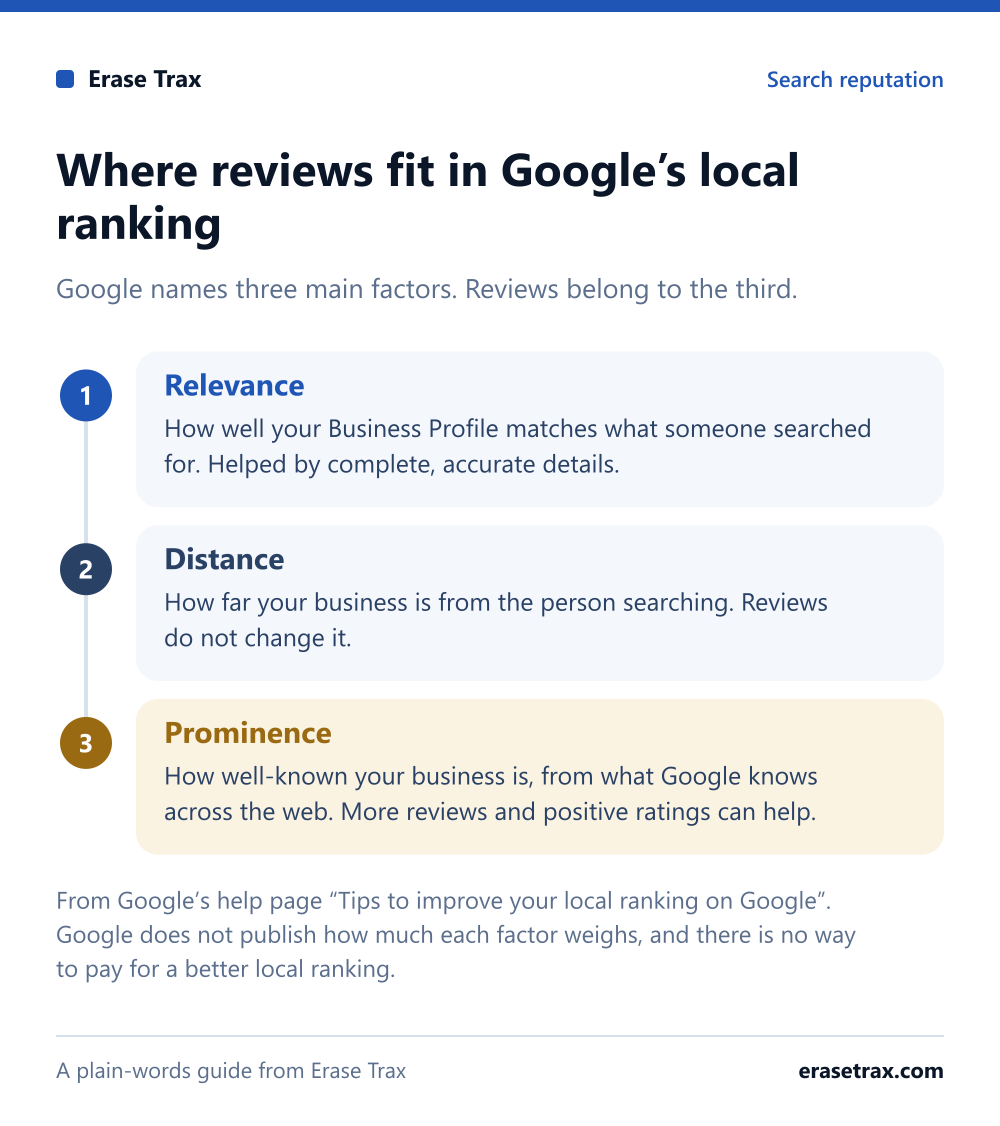
Google’s help page tips to improve your local ranking on Google names three main factors. Relevance is how well a Business Profile matches what someone is searching for. Distance is how far each business is from the person searching. Prominence is how well-known a business is.
A combination of the three decides which businesses appear, and in what order, in the map and the local results. That is why a business with fewer reviews can still outrank one with more: it may be closer, or a better match for the exact search.
- RelevanceHow well your Business Profile matches what someone searched for. Helped by complete, accurate details.
- DistanceHow far your business is from the person searching. Reviews do not change it.
- ProminenceHow well-known your business is, from what Google knows across the web. More reviews and positive ratings can help.Reviews count here
From Google’s help page “Tips to improve your local ranking on Google”. Google does not publish how much each factor weighs, and there is no way to pay for a better local ranking.
Google’s three local ranking factors, and where reviews sit among them.Save the graphic
Where do reviews fit in?
Under prominence. Google says prominence takes into account what it knows about a business from across the web, including links to it and its reviews, and puts it plainly: more reviews and positive ratings can help your business’s local ranking. Prominent places are more likely to show up in search results.
Google does not publish how much weight reviews carry, whether newer reviews count for more, or whether the words in a review matter. Anyone quoting a precise figure for any of these is guessing, however confident they sound.
Does the star rating matter, or only the number of reviews?
Google names both: more reviews and positive ratings. In practice both also affect the customer. Someone comparing three businesses in the map sees each one’s rating and review count before anything else and clicks the one that looks safest, so a good ranking with a weak rating can still lose the customer.
Why does a business with fewer reviews sometimes rank higher?
Because reviews are one part of one factor. A business with forty reviews can sit above one with four hundred when it is closer to the person searching, or when its profile matches the search more closely: the right category, the service named, the area it covers stated. Prominence also takes in more than reviews: Google mentions links to the business and what it knows about it from across the web.
This cuts both ways. If you are losing to a rival with fewer reviews, look first at relevance: is your profile complete, and does it describe what people are actually searching for? If you are winning with fewer reviews, do not assume it will last; a rival that builds genuine reviews steadily is building prominence you are not.
How quickly do new reviews affect ranking?
Google does not say, and nobody outside Google knows. A steady flow of genuine reviews does keep a profile current for the customers reading it, whatever it does for ranking, and a sudden burst of reviews looks unusual to platforms and readers alike. Asking every customer, every week, is better than a campaign once a year.
Do fake reviews help rankings?
Not for long, and they put everything else at risk. Google’s policy treats paid, incentivized and fake reviews as content it removes, and in the US and UK buying them is now against the law. When fake reviews are taken down, the rating built on them goes too. We set the policies out in can businesses offer incentives for reviews? and the law in are fake reviews illegal?.
Do fake negative reviews hurt your ranking?
They lower your rating, and Google lists positive ratings as part of prominence, so a run of fake one-star reviews works against you twice, on the ranking and on the click. That is one reason it is worth acting on reviews that violate Google’s policies rather than waiting for them to be buried. Our Google review removal service takes on the ones that qualify and is only invoiced once a removal is verified.
Does replying to reviews help?
Google recommends it. Its local ranking page says that replying to customer reviews shows you value their feedback, and that positive reviews and helpful replies can help a business stand out. It does not say replies are a ranking factor in themselves, so the honest reason to reply is the customer reading them: see how to respond to negative reviews without losing customers.
Can you pay Google for a better local ranking?
No. Google’s help page says there is no way to request or pay for a better local ranking on Google. Ads can put a business in sponsored slots, labeled as such, but they do not change where the business ranks in the unpaid local results.
What else does Google say improves local ranking?
- Verify your businessthe first tip on Google’s list.
- Keep your information up to datecomplete, accurate details help Google match you to the right searches (relevance).
- Respond to reviewsreplies show you value feedback.
- Add photos and videosthey show customers what you offer.
- Add productsfor businesses that sell products in store.
That list is the honest core of local SEO services: a complete, accurate profile, a website that agrees with it, and a steady flow of genuine reviews.
What should a business actually do?
- Ask every customer for an honest review, at the moment they are happiest, with nothing offered in return.
- Reply to every review, good and bad, calmly and in public.
- Keep your profile complete and accurate: categories, hours, services, photos.
- Deal with reviews that violate Google’s policies, rather than letting fake ones drag the rating down.
To see where your profile stands, the free review audit shows which of your reviews violate Google’s policies and what a realistic rating looks like without them.
Sources
- Tips to improve your local ranking on GoogleGoogle Business Profile Help
- Prohibited and restricted content, Maps user-generated content policyGoogle
The policies and laws above are the platforms’ and regulators’ own pages. This article explains them in plain words; it is not legal advice.
About this guide
Written by the Erase Trax review team: specialists in review policy, working with businesses in the United States, the United Kingdom, Canada, Australia and the United Arab Emirates. Each guide is written against the platforms’ own published policies. Last reviewed .
- We never need your login
- We never buy, write or incentivize reviews
- The platform makes the final decision