In this article9 sections · 8 min
- Where do AI answers get review data?
- What does ChatGPT say about my business reviews?
- Why does one bad theme keep getting repeated?
- How do AI Overviews use Google reviews?
- What can and cannot you influence?
- How do removal and genuine new reviews change the summary?
- How do you check what AI says about your business?
- A note on the law
- Where to start
Where do AI answers get review data?
Google describes AI Overviews as an AI-generated snapshot of key information, with links to the pages it draws on so you can dig deeper. For a local business, the obvious source is your Google Business Profile: the star rating, the number of reviews and the words customers used. Around that sit other pages that discuss you, such as industry review sites, directories, local news, forum threads and your own website.
Chat assistants such as ChatGPT work in a similar way when they search the web to answer a question: they pull a handful of pages, read them and write a summary. When they do not search, they rely on what they learned in training, which can be out of date. Neither Google nor the assistant makers publish a full list of which sources they prefer or how much weight each one gets, so be wary of anyone who claims to know the exact formula.
What you can say with confidence is this: the material is public, and most of it is written by your customers. The platforms that matter most for your trade are the ones most likely to be read, which is why it is worth knowing which review sites matter for your business.
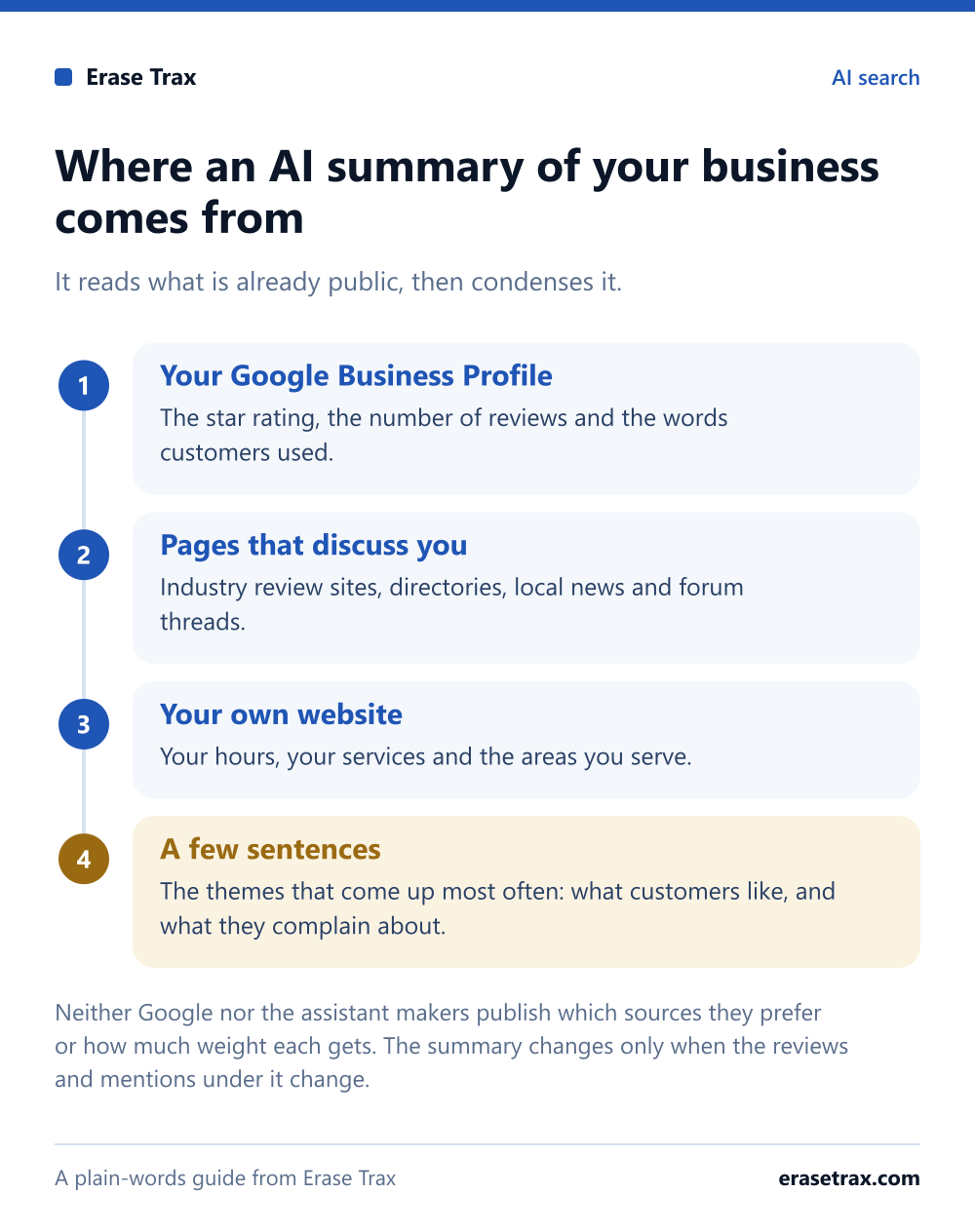
- What it readsYour Google Business ProfileThe star rating, the number of reviews and the words customers used.
- Pages that discuss youIndustry review sites, directories, local news and forum threads.
- Your own websiteYour hours, your services and the areas you serve.
- What it writesA few sentencesThe themes that come up most often: what customers like, and what they complain about.The summary
Neither Google nor the assistant makers publish which sources they prefer or how much weight each gets. The summary changes only when the reviews and mentions under it change.
What an AI answer reads, and what it writes from it.Save the graphic
What does ChatGPT say about my business reviews?
Usually something short and balanced-sounding: an overall impression, two or three things customers like, and one or two things they complain about. A typical shape, invented here as an example, reads like “Customers praise the friendly staff and fair prices, though several mention long waiting times.” That last clause is the part owners notice, and it is the part worth understanding.
The answer also varies. Ask twice, phrase the question differently, or ask on a different day, and you may get a different emphasis. Google itself says AI responses may include mistakes and advises checking important information in more than one place. So treat any single answer as a sample of how your reputation reads, not as a fixed verdict.
Why does one bad theme keep getting repeated?
A summary is built to capture what comes up again and again. If ten reviews out of a few hundred mention the same problem, that problem is a pattern, and a pattern is exactly what a summary is designed to report. One angry review about something unusual tends to fade into the background. Five calm reviews that each mention slow callbacks do not.
Three things make a theme stick harder than it should:
- Few recent reviews. If new reviews have slowed, older complaints carry more weight, much as they do in your star average. We explain that arithmetic in why did my Google rating drop?.
- The same complaint on several sites. A theme that appears on Google, on an industry site and in a forum thread looks well supported, even if it started with one incident.
- Reviews that should not be there. Fake reviews, reviews from people who were never customers, or a coordinated attack can create a theme that does not reflect real experience at all.
How do AI Overviews use Google reviews?
Google does not publish a step-by-step account of how AI Overviews read reviews. What it does say is that the overview gives a snapshot and links to supporting pages, and that the feature can make mistakes. In practice, for a query about a named local business, the review content on that business’s profile is among the most relevant public material available, so the themes in your reviews are what you should expect to see reflected.
Reviews matter to the ordinary local results too. Google says prominence, one of its three main local ranking factors, is based partly on how many reviews you have, and that more reviews and positive ratings can help local ranking. We cover that in do Google reviews affect local ranking?. The same reviews therefore shape whether you appear and how you are described.
What can and cannot you influence?
You cannot edit an AI answer, pay to change it, or ask Google or an assistant to rewrite what it says about you. You also cannot remove a genuine review because you dislike it. A fair complaint from a real customer stays up, and it should.
What you can influence is the material the summary is built from:
- Whether reviews that violate platform policy stay up. Google’s content policy for Maps does not allow fake engagement, conflicts of interest or off-topic content, among other things. Reviews like that can be reported through Google’s official channels, and Google makes the final decision.
- How many recent, genuine reviews you have. Asking every customer, the same way, with nothing offered in return, is the steady way to make the summary reflect your business as it is today.
- Whether the real problem is fixed. If the theme is true, the most reliable way to change it is to fix the cause and let new reviews say so.
- What your own pages say. A clear website and an accurate Business Profile give AI tools correct facts such as hours, services and areas served, so they do not have to guess.
Anything beyond that, such as buying reviews, offering discounts for five stars or writing reviews yourself, violates platform policy, and in many places it also raises legal issues. It also tends to backfire: Google’s policy says fake engagement is removed, and a sudden wave of removed reviews can leave the profile weaker than before.
How do removal and genuine new reviews change the summary?
They change it the only honest way: by changing what the AI reads. If a run of fake one-star reviews created a theme such as “several customers report rude staff” and Google removes them for violating its policy, the theme loses its support. If a slow quarter left a two-year-old complaint near the top, a flow of new, genuine reviews pushes it into the past and gives the summary fresher material.
Two cautions. First, there is no fixed timetable. Google decides each report on its merits, and AI tools refresh what they read on their own schedules, so a change in the reviews does not show up in an answer straight away. Second, neither step guarantees a particular wording. The aim is a summary that reflects real customers accurately, and that is a goal you can actually reach.
This is the approach we take for businesses that want it done for them: we report only reviews that violate the platform’s policy, through the platform’s own channels, without ever needing your login, and we help you gather genuine reviews without incentives. You pay for a removal only once it is verified.
How do you check what AI says about your business?
Do it the way a customer would, and write it down so you can compare later:
- Search Google for your business name with words such as “reviews”, “is it good” or “complaints”, and note whether an AI Overview appears and what it says.
- Ask one or two chat assistants the same plain questions, such as “What do customers say about [your business] in [your town]?”
- Ask each question two or three ways, because answers vary with wording.
- For each theme in the answers, find the reviews behind it. Sort your Google reviews by newest and look on the other sites the answer links to.
- Sort what you find into three groups: fair complaints to fix, reviews that may violate policy, and gaps where you simply need more recent reviews.
- Repeat every month or so. You are looking for the trend, not a single answer.
If an AI answer states something plainly wrong, such as the wrong hours or a service you do not offer, fix the facts at the source first: your Business Profile and your website. Google also lets users give feedback on an AI Overview with the thumbs-down option, which is worth using for factual errors.
A note on the law
Fake reviews and paid-for reviews are regulated in the US, the UK, Canada and Australia, and the law differs between them. This article is not legal advice. If a review may be defamatory or you are weighing legal action, speak to a qualified lawyer in your country.
Where to start
If the AI summary of your business keeps repeating a theme you do not recognize, start with the reviews behind it. Our free audit goes through your profile and sorts each review into those that may violate the platform’s policy and those that do not, with a plain view of what can realistically change.
Sources
- Find information in faster and easier ways with AI Overviews in Google SearchGoogle Search Help
- Prohibited and restricted content (Maps user-generated content policy)Google
- Tips to improve your local ranking on GoogleGoogle Business Profile Help
The policies and laws above are the platforms’ and regulators’ own pages. This article explains them in plain words; it is not legal advice.
About this guide
Written by the Erase Trax review team: specialists in review policy, working with businesses in the United States, the United Kingdom, Canada, Australia and the United Arab Emirates. Each guide is written against the platforms’ own published policies. Last reviewed .
- We never need your login
- We never buy, write or incentivize reviews
- The platform makes the final decision