In this article14 sections · 12 min
- First, check that it really dropped
- Cause one: new negative reviews
- Cause two: some of your good reviews disappeared
- Cause three: too few new reviews
- Cause four: a real problem in the business
- Cause five: an attack from people who were never customers
- Cause six: reviews meant for someone else
- Could it be a fault on Google’s side?
- How to tell which cause you have, in ten minutes
- What customers actually notice about your rating
- What if one review did all the damage?
- What not to do while you work it out
- Getting the rating back up
- When to get help
First, check that it really dropped
Before you look for a cause, make sure you are comparing like with like. The rating Google shows is rounded to one decimal place, so a profile can move from 4.75 to 4.74 and the display can jump from 4.8 to 4.7 without anything dramatic happening. The rating you see in the map on your phone, in a search result on your laptop and inside your Business Profile manager can also be read at slightly different moments, so two screens may briefly disagree.
So open your profile, sort the reviews by newest, and look at what has arrived and what has gone since the last time you were happy with the number. Write down the rating, the total number of reviews, and the date. That gives you a fixed point to measure from, and it is exactly what you will need if the cause turns out to be one of the harder ones below.
Cause one: new negative reviews
The most common reason, and the easiest to see: one or more new one- or two-star reviews at the top of the newest list. They do hurt, and the useful question is which kind they are. A fair complaint from a real customer, an unfair one, a review meant for someone else, or one that violates Google’s policies each need a different answer.
If you have just received one and you are not sure what to do first, we walk through it in what to do when you get a bad review. The short version: wait before you reply, check your records, reply once and calmly, fix what is real, and only challenge what violates policy.
Cause two: some of your good reviews disappeared
This one confuses owners the most, because nothing new appears: the total number of reviews goes down, and the average goes down with it. Google moderates reviews continuously, with automated systems and with people, and its policy says content that is not based on a real experience, or that comes from a conflict of interest or an incentive, is removed. Sometimes that sweep catches reviews you did not expect.
Think about where your positive reviews came from. Picture an invented example: a café asks every customer to leave a review on a tablet at the counter, and the reviews arrive from the same device in the same building. Or a firm’s staff and their families reviewed it when it opened. Or a marketing company once offered a discount for five-star reviews on the firm’s behalf. Any of these can look, to Google, like reviews that violate its policies, and they can be removed months later, all at once. Google’s policy specifically mentions pressuring customers to review on the premises, staff review quotas and incentives.
If this is what happened, there is no shortcut back, and asking for the removed reviews to be restored is not the answer. The reviews are gone because of how they were gathered, and the fix is to gather new ones properly: every customer asked the same way, on their own device, with nothing offered in return. We set the policies out in can businesses offer incentives for reviews?.
Cause three: too few new reviews
Sometimes nothing is wrong at all except volume. If a business stops getting new reviews, the old ones carry all the weight, and the next bad review lands on a profile that has nothing new to cushion it. In that case the rating dropped because one review counted for more than it should have, and not because the service got any worse. A profile that has gone quiet for a few months is more exposed than its number suggests.
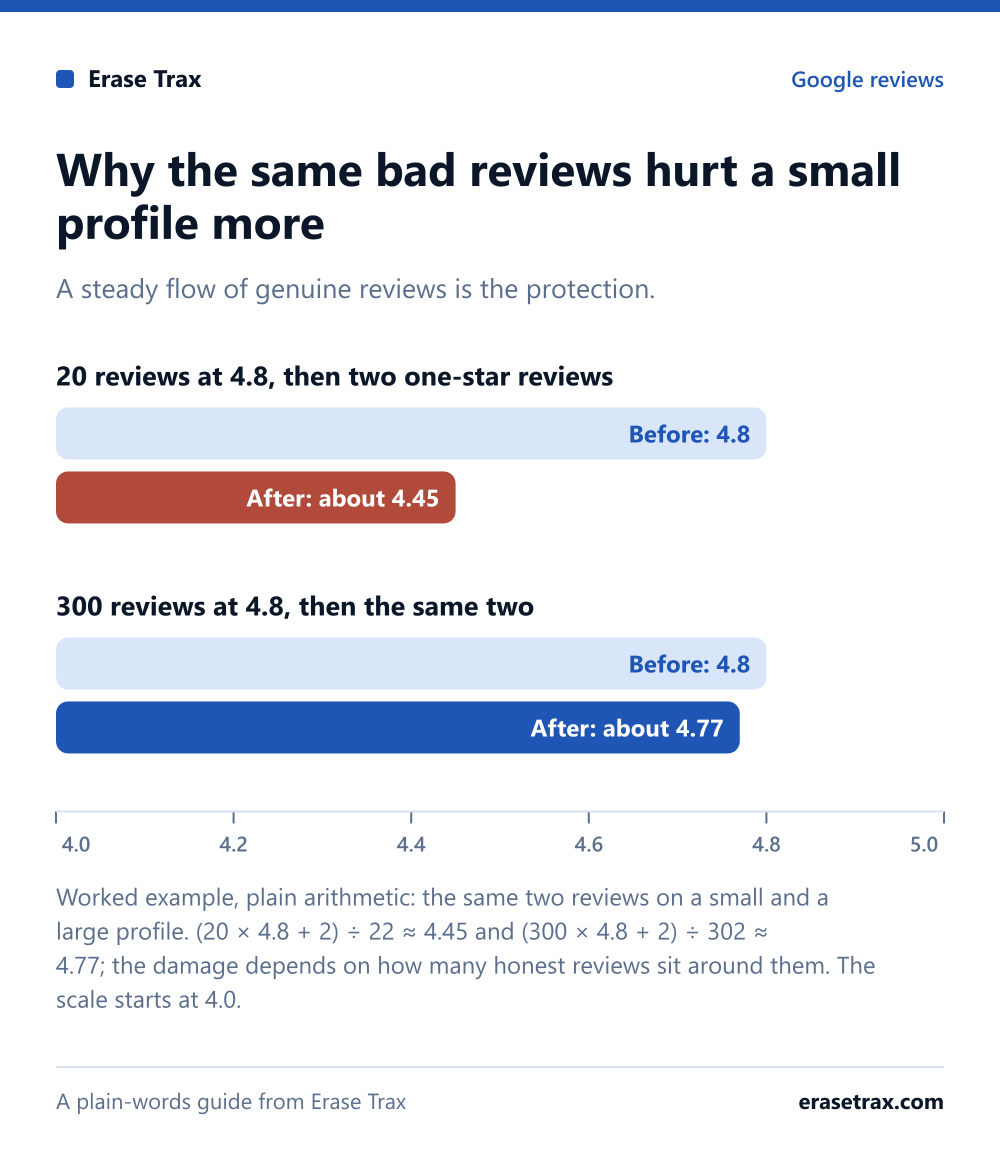
Take the arithmetic as a worked sum rather than anything that happened. A profile with 20 reviews averaging 4.8 that receives two one-star reviews falls to about 4.45. A profile with 300 reviews at the same average, receiving the same two reviews, falls to about 4.77. The two new reviews are identical in both cases, so the whole difference comes from how many honest reviews sit around them.
Google shows it rounded: 4.5
- 20 reviews at 4.8, then two one-star reviews4.8 → about 4.45
- 300 reviews at 4.8, then the same two4.8 → about 4.77
Worked example, plain arithmetic: the same two reviews on a small and a large profile. (20 × 4.8 + 2) ÷ 22 ≈ 4.45 and (300 × 4.8 + 2) ÷ 302 ≈ 4.77; the damage depends on how many honest reviews sit around them. The scale starts at 4.0.
The fix is the least exciting and the most reliable thing in this article: ask every customer for a review, every week, at the moment they are most pleased. Offer nothing in return, filter no one out, and stay within every platform’s policies.
Cause four: a real problem in the business
If the newest reviews are fair, specific and from customers you can find in your records, and several of them mention the same thing, the rating is telling you something true. A new member of staff, a supplier change, a busy season that stretched the team, a price rise that was not explained well: these show up in reviews before they show up anywhere else.
This is the one cause where reputation work comes second. Fix the problem first. Then reply to each review honestly, saying what has changed, so the next customer sees, beside the complaint, that it was heard. Readers forgive a business that had a bad month and fixed it; they do not forgive one that pretends nothing happened.
Cause five: an attack from people who were never customers
Sometimes several one-star reviews arrive within hours or days, from accounts you cannot find in your records, often vague or repetitive, and sometimes after something public such as a post, a news story or a dispute. If that is what you see, you may be looking at review bombing. Occasionally it is followed by a message offering to make the reviews go away for a fee, which is a well-known extortion scam.
These reviews violate Google’s policies because they are not based on a real experience, and they are strongest challenged as one pattern rather than as many separate complaints. Do not pay anyone, do not reply angrily to each one, and do not ask friends to post positive reviews to balance them. Read review bombing: what to do when bad reviews arrive at once and, if money has been demanded, Google review extortion scams.
Cause six: reviews meant for someone else
The last common cause is the simplest. If your business shares a name, a building or a street with another firm, customers sometimes review the wrong one. You will recognize these by details that do not fit: a service you do not offer, a member of staff you have never employed, a branch you do not have. A polite reply often gets the reviewer to move it; if not, a review about a different business can be challenged. See a Google review left on the wrong business.
Could it be a fault on Google’s side?
Occasionally, yes. Reviews can be held back for a while, filtered by mistake, or briefly fail to show, and owners do sometimes see their count wobble for a few days before settling. If your review count has fallen and you are certain the missing reviews came from real customers, asked fairly, with nothing offered, it is worth noting which ones are missing and checking again over the following days.
What is rarely worth doing is assuming the fault is Google’s and waiting. In most cases the cause is one of the six above, and every week spent waiting is a week in which nothing is being fixed. Start with the checklist below; if it points nowhere, then look at Google.
How to tell which cause you have, in ten minutes
You can do this without any software, using your profile, your records and an hour of quiet.
- Sort your reviews by newest and note the date the rating last looked right.
- Count the reviews that have arrived since then, and their stars.
- Compare the total number of reviews today with the number you remember. If it went down, reviews were removed.
- For each new low review, check your records: a real customer, a mistake, or nobody you know?
- Look at the timing: spread across weeks, or bunched into a day or two?
- Read the content: specific and recognizable, or vague, repeated and generic?
Spread-out, specific reviews from real customers point to causes one, three or four. A fall in the total points to cause two. Bunched, vague reviews from strangers point to cause five. Details that do not fit your business point to cause six. Most falling ratings turn out to be a mix of two of these, typically a few new bad reviews landing on a profile that had stopped growing.
What customers actually notice about your rating
It is easy to treat the number as the whole story, because it is the number you watch. Customers read a profile differently. They glance at the rating, then at how many reviews it is based on, then at the most recent few, and then, if anything worries them, at how the business replied. A 4.4 from three hundred reviews, with recent praise and calm replies, often wins a customer that a 4.9 from nine reviews does not.
That is worth remembering when the number falls. A drop of a few tenths feels dramatic from the inside, but to a customer it is one signal among several, and you have more control over the others than over the number itself. The most recent reviews are the ones you can influence soonest, by asking happy customers today. The replies are the ones you can fix this afternoon. Start there while you work on the rest.
What if one review did all the damage?
On a small profile, a single review can move the rating a long way, and it is natural to want that one review gone. Whether it can go depends entirely on what kind of review it is, not on how much damage it did. A genuine customer’s one-star review stays up however much it costs you; a review from someone who was never a customer, from a rival or a former employee, or one meant for another business, can come down.
If it is the first kind, the answer is a good reply and more reviews: the damage one review does shrinks with every honest review that arrives after it. If it is the second kind, it is worth challenging properly, once. Either way, do not let one review decide how you feel about the whole profile. In a year it will be one of many, and what readers notice is whether the business behind it looked after its customers.
What not to do while you work it out
- Do not post reviews yourself, or ask staff, friends or family to. They are a conflict of interest under Google’s policies and they are exactly the kind of review that gets removed in the next sweep.
- Do not buy reviews or pay for a “rating boost”. In the US and the UK it is now against the law as well as platform policy; see are fake reviews illegal?.
- Do not offer discounts or freebies for reviews. Incentivized reviews are removed, and they can take your genuine ones with them.
- Do not delete and recreate your profile. You lose every good review with it.
- Do not report every low review. Reports on genuine opinions do not work, and a flood of them from your side does nothing for your standing.
Getting the rating back up
Whatever the cause, the recovery has the same three parts, in this order.
First, deal with the reviews that should not be there. Reviews from people who were never customers, from competitors or former staff, reviews meant for another business, and reviews that are abusive or name your team violate Google’s policies, and each one that comes down puts the average back where your real customers put it. Our review removal service handles these for you, and you are only invoiced for a removal once it is verified on your live profile.
Second, answer the ones that should be there. Every genuine low review deserves a calm, public reply that says what you did about it. It will not change the number, but it changes what the number means to the person reading.
Third, grow the profile honestly. A steady flow of genuine reviews is the only thing that moves the average in a lasting way, and the only protection against the next bad review weighing too much. There is no trick that replaces it, and every trick that claims to ends up as cause two.
When to get help
If you have worked through the checklist and the cause is a mix you cannot untangle, or the drop is steep enough to be costing you calls, it is worth having someone look at the whole profile. Send it to us: the free audit comes back within 24 hours and sorts every review into what violates Google’s policies and what does not, with a plain account of what a realistic rating looks like once the policy-violating ones are dealt with. And if you would rather never be surprised by the number again, a review monitoring service sends you each new review as it lands.
About this guide
Written by the Erase Trax review team: specialists in review policy, working with businesses in the United States, the United Kingdom, Canada, Australia and the United Arab Emirates. Each guide is written against the platforms’ own published policies. Last reviewed .
- We never need your login
- We never buy, write or incentivize reviews
- The platform makes the final decision