In this article8 sections · 6 min
What Google’s policy actually says
Google’s policy for reviews on Maps lists conflict of interest as a reason a review is not allowed. It names the relationships it means, and current or former employment is one of them, alongside competitors and family. You can read the wording in Google’s prohibited and restricted content policy.
The reasoning is that a review is meant to describe an experience as a customer. Someone who worked for the business has a stake in how it looks, in one direction or the other, so their review is not the independent account a reader assumes it is. That applies as much to the angry review an ex-employee leaves as to the glowing one a manager’s cousin leaves.
“The review is unfair” is not the ground
This is where most owners go wrong. They report the review because what it says about the business is untrue, or exaggerated, or bitter. Google does not act on any of those. It removes a review only when the review violates one of its policies.
The policy point here is the relationship. Owners tend to start from "this person is lying about us", when the case to make is "this person worked for us, which is a conflict of interest under your policy". Whether their complaint has any truth in it then stops being the question, and whether the connection can be shown becomes the whole question.
Which ex-employee reviews qualify, and which do not
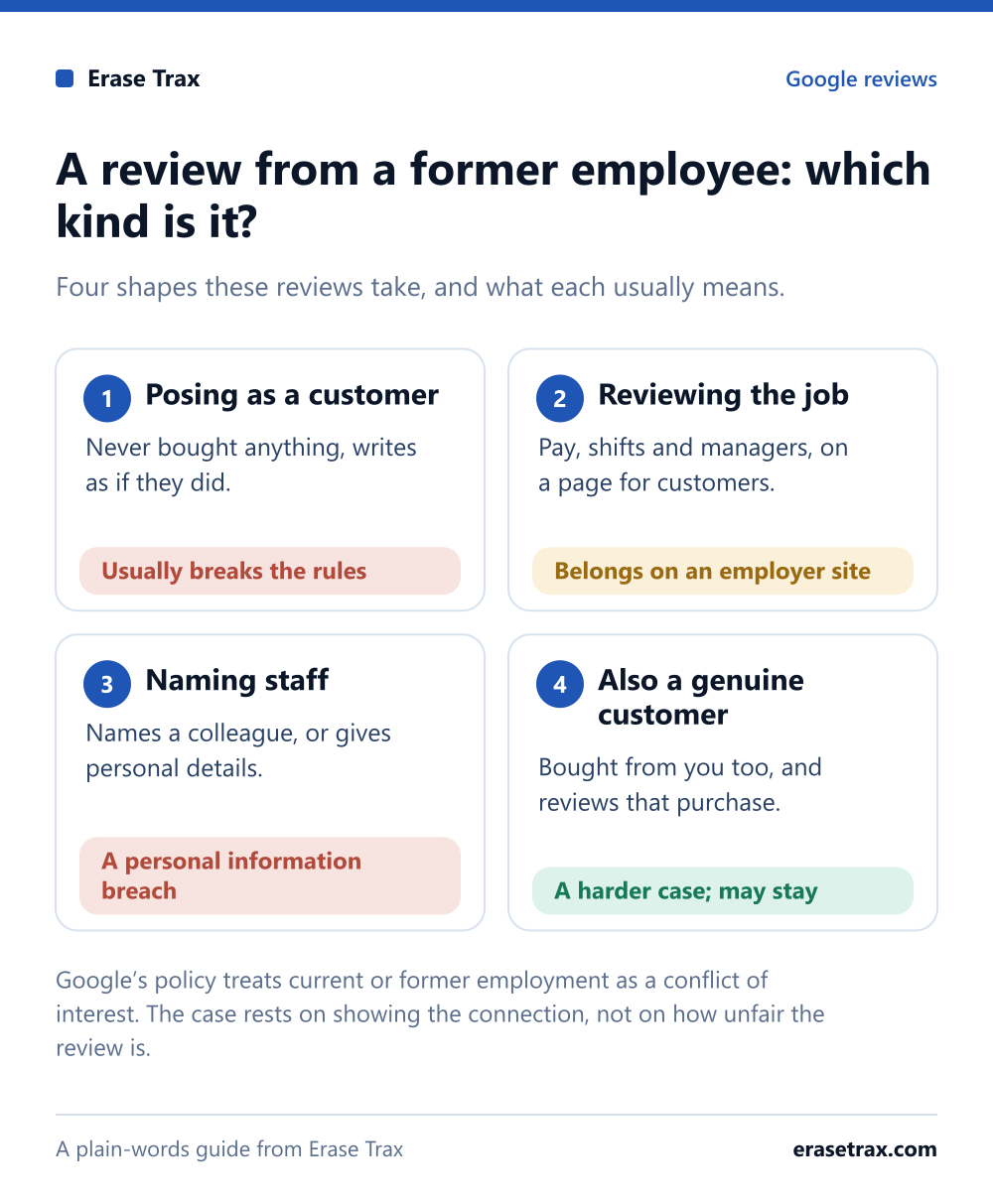
- Posing as a customerthe reviewer writes as if they bought something, and never did. This is the clearest case: a conflict of interest and no genuine customer experience, both at once.
- Reviewing the job, not the servicethe review is about pay, managers or shifts. That is an employment complaint on a page for customers, and it belongs on an employer-review site instead.
- Naming staffthe review names a colleague, especially with personal details. Personal information is a separate breach, whoever wrote it.
- Also a genuine customersome former employees really did buy from you as well, before or after. Their review of that purchase may be allowed, and it is a harder case to make.
If someone was both an employee and a customer, and the review describes the customer experience, it is not automatically against policy. We would tell you that at the audit rather than take your money for a case that is unlikely to hold.
- Posing as a customerNever bought anything, writes as if they did.Usually breaks the rules
- Reviewing the jobPay, shifts and managers, on a page for customers.Belongs on an employer site
- Naming staffNames a colleague, or gives personal details.A personal information breach
- Also a genuine customerBought from you too, and reviews that purchase.A harder case; may stay
Google’s policy treats current or former employment as a conflict of interest. The case rests on showing the connection, not on how unfair the review is.
Four shapes a former employee’s review takes, and what each usually means.Save the graphic
Why these reviews are harder to see than they look
An ex-employee rarely posts under their full name. They use a nickname, an initial or a new account, and the review may be written to sound like a customer on purpose. The owner usually knows who it is from the timing and the details: the shift that is mentioned, the colleague who is described, the week it appeared.
Being sure who wrote it is not enough on its own. A case built on "we are sure it is them" asks the platform to take your word for it, and the platform cannot do that. A case built on records that genuinely cover the connection does not ask it to. Preparing that is the part our team does, and it is why we do not describe it as a quick report.
What not to do
Three mistakes make a conflict-of-interest review harder to deal with, and each of them is tempting in the moment.
- Do not name the person in your public reply. Saying "this is a disgruntled former employee called…" discloses personal information about them on a public page, and it is the kind of reply that ends up as a screenshot.
- Do not contact them to demand removal. A message that can be read as a threat helps nobody, and in the United States the FTC’s rule on reviews bars using groundless threats to remove a negative review.
- Do not ask current staff to post positive reviews to balance it out. That is a conflict of interest too, in the other direction, and it puts your own profile at risk.
How to reply in the meantime
A calm public reply protects you whatever happens to the review. Keep it short, do not argue the details, and do not reveal who you think wrote it. Something like the example below is enough.
Illustrative: “Thank you for taking the time to write. We could not match this to a customer visit in our records. If you were a customer and we let you down, please contact us directly so we can put it right.”
A reader who sees that reply next to a bitter review draws their own conclusion, and it is usually the right one. For more on tone, see how to respond to negative reviews without losing customers.
Where employment reviews belong
Former employees are entitled to review an employer; Google Maps is simply not the place for it. Sites like Glassdoor exist for exactly that, with their own policies, and a fair, honest employer review there is not something to fight. We explain what Glassdoor will and will not take down in Glassdoor review removal: what Glassdoor takes down.
What this comes down to
A former employee reviewing your business as if they were a customer is a conflict of interest under Google’s own policy, and that is a real ground for removal. The case rests on the connection, which has to be shown with records; how unfair the review is does not decide it. If you think one of your reviews is from an ex-employee, a free audit of your profile will tell you whether it qualifies before you spend anything, and our review removal service is only invoiced for removals verified on your live profile.
About this guide
Written by the Erase Trax review team: specialists in review policy, working with businesses in the United States, the United Kingdom, Canada, Australia and the United Arab Emirates. Each guide is written against the platforms’ own published policies. Last reviewed .
- We never need your login
- We never buy, write or incentivize reviews
- The platform makes the final decision