In this article8 sections · 7 min
Why it matters to any business
It does not matter whether you run a café, a dental clinic, a law firm or a garage. One unfair review, especially a fake one, can sit on your profile for months and turn away customers who never speak to you: they see the star rating and move on.
Removal is not about hiding every bad review. Genuine feedback, even harsh feedback, has its place. But a review that is fake, posted by a competitor, full of personal attacks or left on the wrong business should not be the thing that decides whether a customer picks up the phone or scrolls past you.
The policy point most owners miss
Google treats every review as an opinion until it is shown to be something else. A customer is allowed to be blunt, disappointed, dramatic or unreasonable. None of that violates a policy. What a reviewer is not allowed to do is post content that falls under Google’s prohibited and restricted content policy for user contributions.
So the question is never “can I get this removed because it is unfair?” The answer to that is no. The question is “which policy does this review violate, and what shows it?” Owners who ask the second question have a case. Owners who write to Google about how the star rating feels get a rejection, because feelings are not what the moderator is checking.
What the policy actually covers
In plain words, Google’s policy prohibits reviews that are not genuine experiences and reviews that misuse the platform. The categories that matter in practice:
- Fake engagementreviews from accounts that were never customers, including paid or incentivized reviews.
- Conflict of interestreviews from competitors, current or former employees, or anyone reviewing their own business.
- Off-topic contenta review about politics, a news story or a staff member’s appearance rather than the visit.
- Harassment, hate speech and personal attacksslurs, threats or abuse aimed at a named person.
- Spam and advertisinglinks, phone numbers, promotional copy, or the same text posted repeatedly.
- Wrong placea review that describes a different business, branch or product. Common with franchises, shared addresses and rebranded stores.
The last category is the least discussed and the most concrete. If a reviewer describes a service you have never offered or a location you have never run, you are not arguing about tone. You are pointing at a factual mismatch, and a mismatch is something a moderator can check.
Why the review is still up after you flagged it
The flag runs an automated check. It reads the words in the review, not the context around it. A competitor who writes “bad service, rude staff, never again” has written a sentence that violates no policy on its own. It looks like an ordinary one-star review. The violation is in the account history, the timing and the fact that no such customer exists in your records. The flag sends none of that.
This is the point where most owners give up — and where the real work begins. An automated no is not a final decision. Getting past it takes far more than the flag ever sent, and it is exactly what we take off your hands: every policy-violating review stays with us until Google gives its final answer.
What a strong case rests on
A complaint says the review is unfair. A case shows which policy it violates, on things Google can check: the reviewer’s history, the timing, a cluster of similar reviews, and a record that no such customer exists. Assembling that and carrying it to a final decision is specialist work, and it is what our team does every day. Your part is small: send the profile for a free audit, and mention any booking record or call log that contradicts the review.
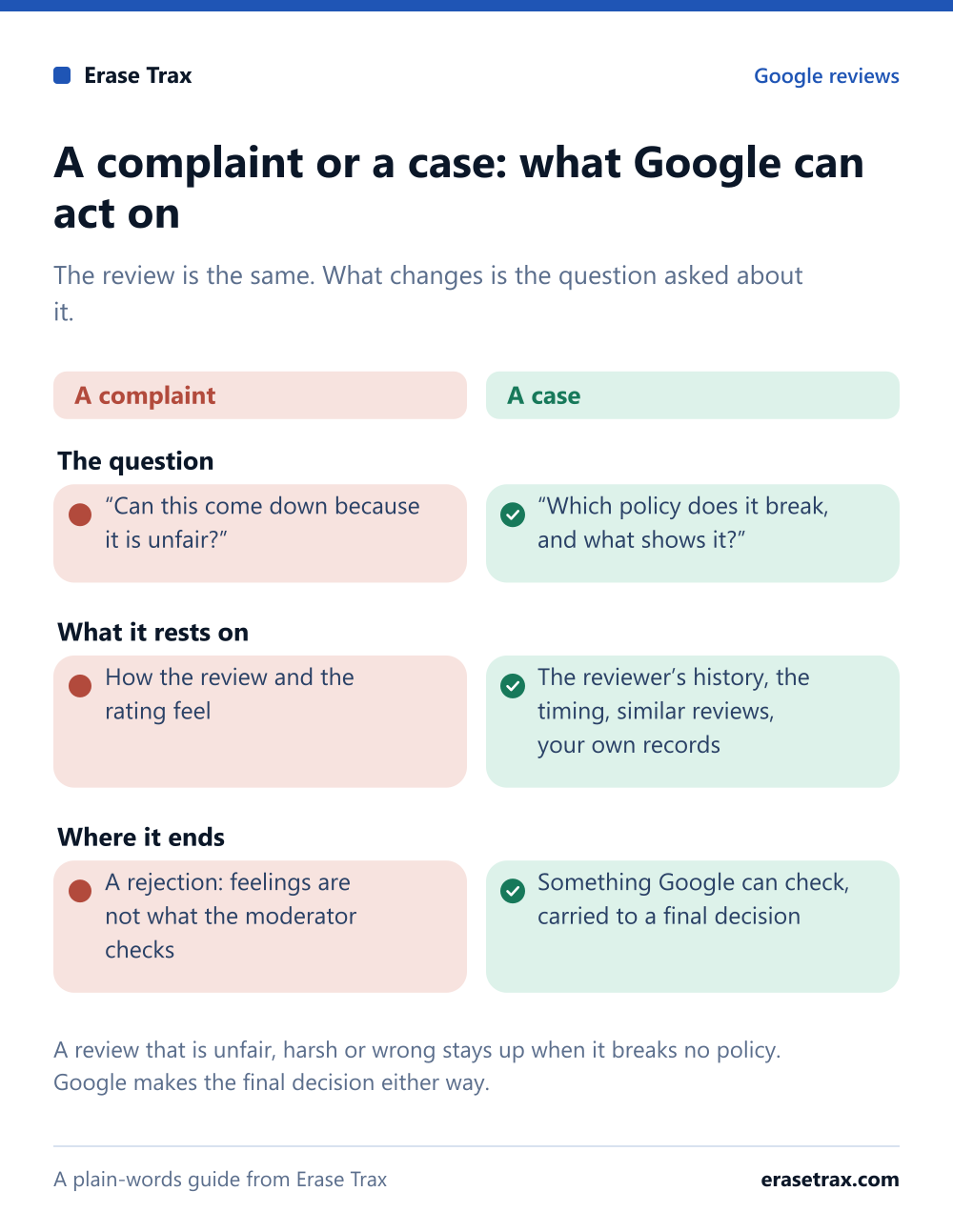
- The question
- A complaint“Can this come down because it is unfair?”
- A case“Which policy does it break, and what shows it?”
- What it rests on
- A complaintHow the review and the rating feel
- A caseThe reviewer’s history, the timing, similar reviews, your own records
- Where it ends
- A complaintA rejection: feelings are not what the moderator checks
- A caseSomething Google can check, carried to a final decision
A review that is unfair, harsh or wrong stays up when it breaks no policy. Google makes the final decision either way.
The same review, asked about two ways.Save the graphic
When the review is real, and it is staying
Sometimes the customer did have a bad experience, and nothing in the review violates a policy. That review is not coming down. Pushing it anyway spends credibility you may need for a review that does qualify.
The reply is where you recover. A calm, specific answer that names the real issue, admits the part you got wrong and offers a way to put it right does more for the next reader than a removal would. Pair that with a steady flow of new reviews from genuine customers, and one bad review stops setting the tone of the profile.
Mistakes that cost the removal
- Arguing in the public reply. A defensive reply gets screenshotted and shared more than the review ever would.
- Flagging from several staff accounts. Coordinated flagging looks like the fake-engagement pattern the policy itself prohibits, and it adds nothing a moderator can act on.
- Offering a refund in exchange for deletion. That breaks policy on your side and gives the reviewer proof you tried to buy silence.
- Waiting. A review that sits for months collects “helpful” votes and starts appearing in search snippets. It does not get easier to remove with age.
What this comes down to
- Google removes reviews that violate a published policy, not reviews that are bad.
- A flag is an automated first check, and most owners stop at its no. With a specialist, a first no is not the end of it.
- Reviewer history, your own records and timing patterns are what a strong case rests on.
- Wrong-business and never-a-customer reviews are the most concrete cases to take on.
- A genuine complaint calls for a good reply, not a fight for removal.
If you are not sure which category a review falls into, send it to us. The audit is free, it says plainly whether the review qualifies, and if it does not we say so rather than taking it on anyway.
About this guide
Written by the Erase Trax review team: specialists in review policy, working with businesses in the United States, the United Kingdom, Canada, Australia and the United Arab Emirates. Each guide is written against the platforms’ own published policies. Last reviewed .
- We never need your login
- We never buy, write or incentivize reviews
- The platform makes the final decision