In this article9 sections · 6 min
- What does Google itself say about timing?
- Why can nobody give you a date?
- What decides how long it takes?
- Why does a report seem to vanish?
- What does a quick decision usually have in common?
- What should I do while I wait?
- When is waiting the wrong plan?
- What does a slow decision cost you?
- What does this come down to?
What does Google itself say about timing?
Google’s help page on reporting reviews says evaluation “typically takes several days”. That is the only timing Google gives. It is not a deadline, and it says nothing about how long an appeal takes. Figures such as “14 days” that circulate online do not come from Google, so treat them as guesses.
Why can nobody give you a date?
Google reviews are moderated at enormous scale, by automated systems first and by people where a case needs a human decision. That queue belongs to Google. No agency, partner program or paid plan gets to the front of it, so a firm that promises a removal "within days" is promising something it does not control.
What you can control is the part before the queue: whether the review actually violates a policy, and whether the case says so clearly. Those two things decide most of the waiting, so the more useful question to ask first is whether this review can be removed at all.
What decides how long it takes?
- How clear the breach isa review full of abuse, or one that names a member of staff and their phone number, is a yes-or-no question. A review that "might be" from someone who was never a customer is a judgment, and judgments take longer.
- Which policy it violatessome grounds can be seen in the review itself; others, like a conflict of interest or no genuine experience, rest on facts outside it. The second kind needs more before anyone can decide.
- Whether the first answer is finalmany reviews are decided on the first look. Where the first answer is no and the case is still sound, there is a second stage, and that adds time.
- How many reviews are involvedone review is one decision. A cluster that arrived together is often better treated as one pattern than as separate complaints, which takes longer to put together but makes a stronger case.
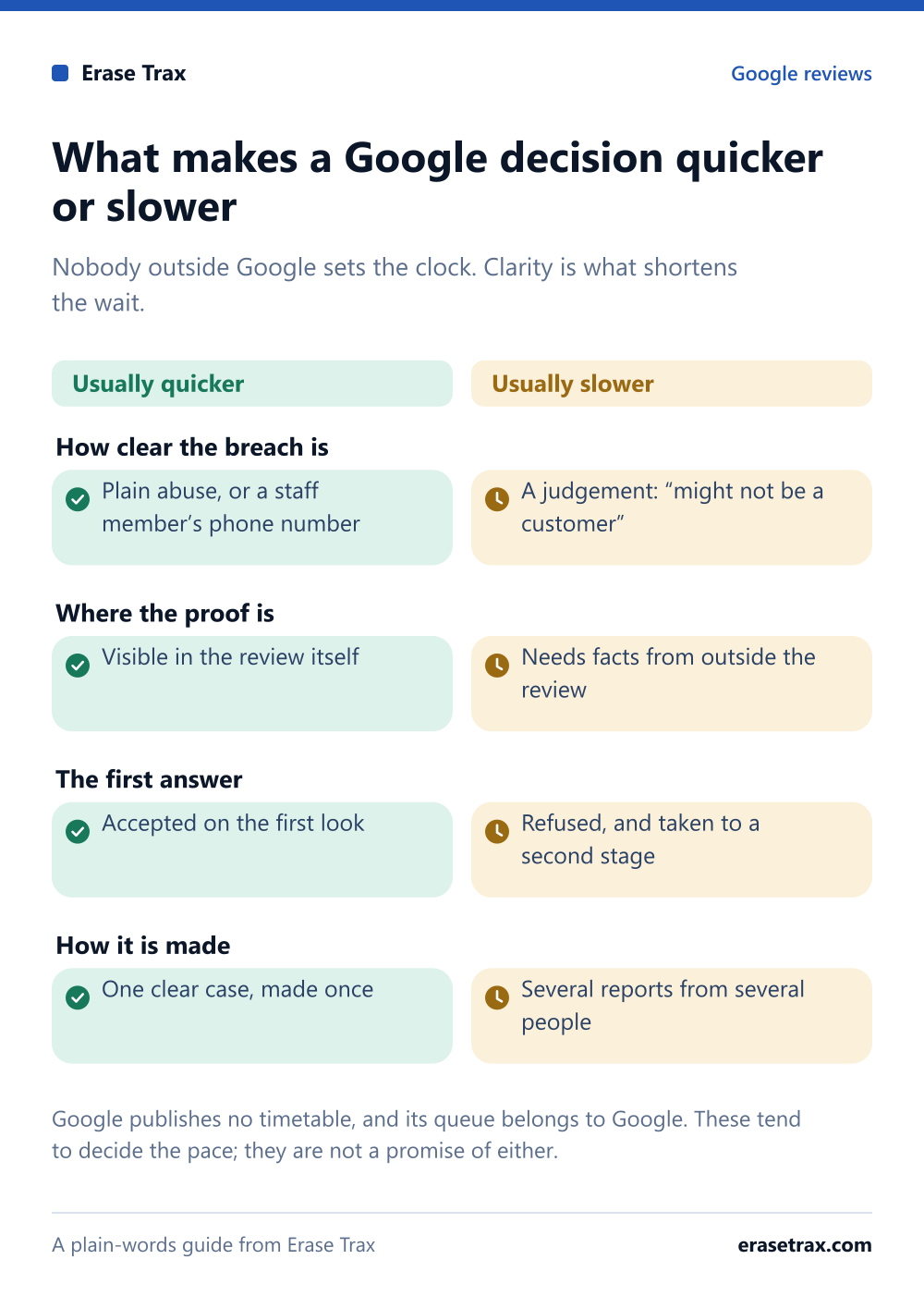
- How clear the breach is
- Usually quickerPlain abuse, or a staff member’s phone number
- Usually slowerA judgment: “might not be a customer”
- Where the proof is
- Usually quickerVisible in the review itself
- Usually slowerNeeds facts from outside the review
- The first answer
- Usually quickerAccepted on the first look
- Usually slowerRefused, and taken to a second stage
- How it is made
- Usually quickerOne clear case, made once
- Usually slowerSeveral reports from several people
Google publishes no timetable, and its queue belongs to Google. These tend to decide the pace; they are not a promise of either.
What tends to make a Google decision quicker or slower. Google gives no fixed timetable.Save the graphic
Why does a report seem to vanish?
The most common experience owners describe is pressing "report", hearing nothing, and finding the review still there weeks later. It is easy to read that silence as a delay. Usually it is the answer: the report was looked at, nothing in it matched a policy, and nothing changed.
This is the part that costs owners the most time. A report that says the review is unfair, or untrue, or from an angry customer, describes a genuine opinion, and Google keeps genuine opinions up, even harsh ones. Waiting on that report is waiting on a decision that has already been made. We explain why in more detail in why reporting a fake review yourself usually fails.
What does a quick decision usually have in common?
Cases that move fast usually name the policy in Google’s own terms, where a slower one describes how the review made the owner feel. Their evidence fits the policy they name, instead of being everything the owner could find. And they are made once, properly, by one person.
Owners often expect the opposite on that last point. When staff, family and friends all report the same review from their own accounts, it feels as if each report adds weight. In practice five reports from five different people add noise, and noise slows everything down. A single case from the owner, on one clear ground, is what gets read properly.
What should I do while I wait?
The review is visible to every customer for as long as it is up, so the waiting time is worth using. Three things help whatever the outcome.
- Reply in public, calmly. A short, factual reply tells every reader that a real person runs the business and that the complaint was taken seriously. It does not affect the removal case, and it protects you if the review stays.
- Keep collecting genuine reviews. New, honest reviews from real customers dilute the bad one in the meantime, and they are the only thing that moves the average while a decision is pending.
- Write down what you know. When the review appeared, what it says, and why you believe it violates a policy. If the case needs a second look, that record is what it is built from.
For a fuller guide to replying, see how to respond to negative reviews without losing customers.
When is waiting the wrong plan?
Some reviews should not be waited on at all. A genuine customer’s one-star review will not come down, however long you give it, and the time is better spent answering it well and earning the next five-star review. Some reviews should be acted on today: a sudden run of one-star reviews from accounts with no history, a review that names your staff, or a message asking for money to make reviews disappear. Those are different situations, and our guides to review bombing and review extortion scams cover them.
What does a slow decision cost you?
With us, a removal is only invoiced once it is verified on your live profile, so a slow decision costs you time and nothing more. Nobody can promise a date, because the date is Google’s. A free review audit tells you which reviews are worth waiting on at all.
What does this come down to?
Google decides in its own time, and nobody outside Google sets the clock. The wait is shorter when the review really violates a policy, the case names that policy, and it is submitted once, cleanly, by one person. The wait is pointless when the review was never removable. Knowing which you have is the first and cheapest step, and you can get a free review audit before you spend any time waiting.
Sources
- Report inappropriate reviews on your Business ProfileGoogle Business Profile Help
- Prohibited and restricted contentGoogle Maps User Contributed Content Policy
The policies and laws above are the platforms’ and regulators’ own pages. This article explains them in plain words; it is not legal advice.
About this guide
Written by the Erase Trax review team: specialists in review policy, working with businesses in the United States, the United Kingdom, Canada, Australia and the United Arab Emirates. Each guide is written against the platforms’ own published policies. Last reviewed .
- We never need your login
- We never buy, write or incentivize reviews
- The platform makes the final decision