In this article7 sections · 6 min
Why this happens more than you would think
Customers do not search carefully when they are angry. They type a name into Maps, tap the first result and start writing. If your business shares a word, a street, a logo color or even a trade with another firm nearby, you will eventually receive their reviews.
- Similar namestwo removal firms called “Swift” in the same county, or a national brand and a local business with the same word in their names.
- Shared buildingsthe dentist upstairs, the restaurant next door, the other tenant in the same unit.
- Former occupantsa customer of the business that used to be at your address, still finding the old pin.
- Franchises and branchesa review meant for one location landing on another, or on the head office.
- Middlemena customer who booked through a broker or marketplace and reviewed the company they found, not the one that did the work.
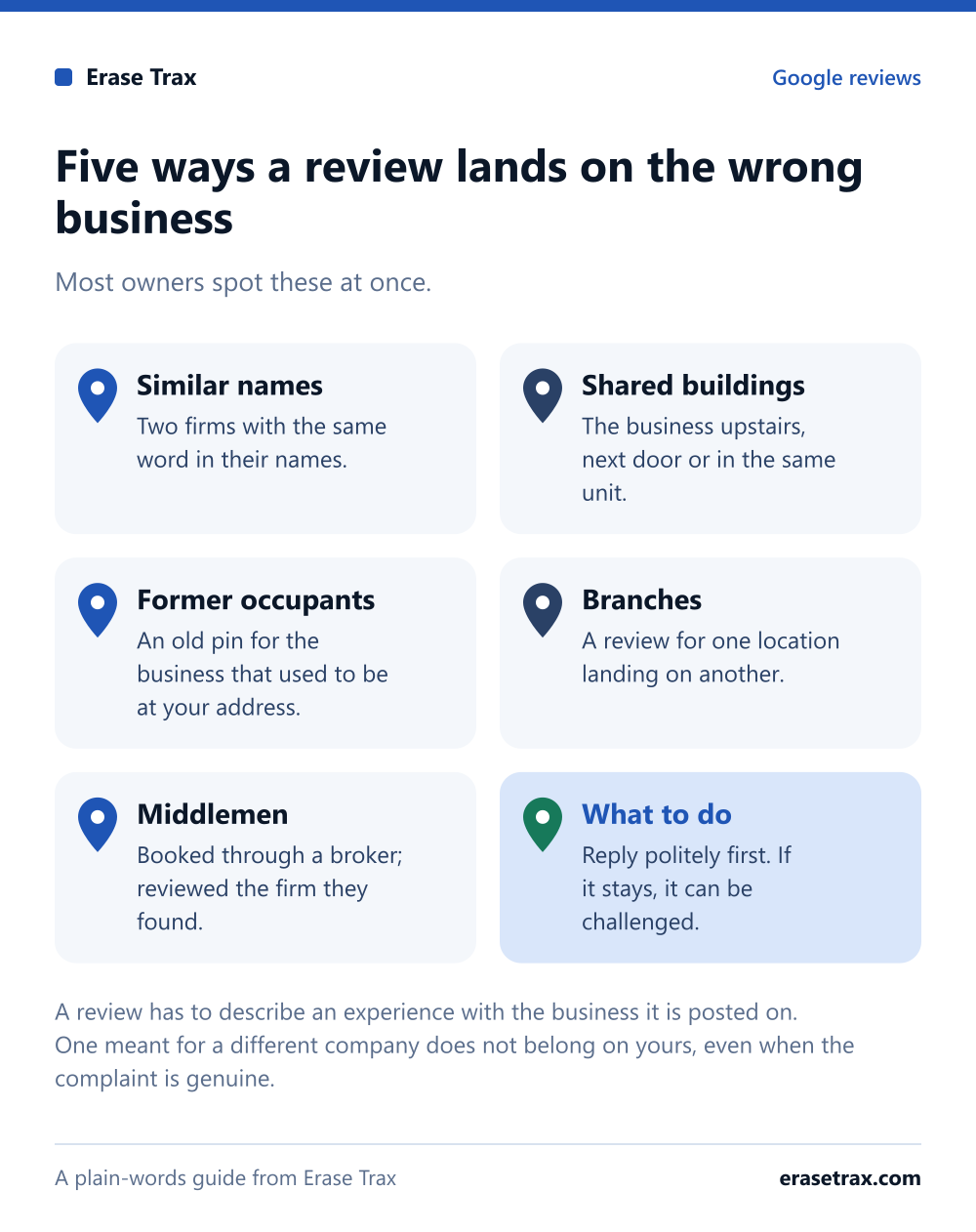
- Similar namesTwo firms with the same word in their names.
- Shared buildingsThe business upstairs, next door or in the same unit.
- Former occupantsAn old pin for the business that used to be at your address.
- BranchesA review for one location landing on another.
- MiddlemenBooked through a broker; reviewed the firm they found.
- What to doReply politely first. If it stays, it can be challenged.
A review has to describe an experience with the business it is posted on. One meant for a different company does not belong on yours, even when the complaint is genuine.
Five common reasons a customer reviews the wrong business.Save the graphic
Why it can come down
A review on Google is supposed to describe an experience with the business it is posted on. When it describes a different business, it is not based on a real experience of yours, and it misleads every reader who sees it. That is a breach of Google’s policies whatever the reviewer meant, and it stays a breach even when every word of the complaint is true of the other business.
That makes these cases different from an ordinary negative review, where you would be asking Google to judge an opinion. Here you are showing Google that the review is attached to the wrong place. For the wider picture of what Google reviews can be removed, see our 2026 guide.
How to tell it is not about you
Most owners spot these instantly, but the signs are worth writing down, because they are what the case is made of.
- Something you do not doa product you do not sell, a service you do not offer, opening hours you have never kept.
- A name you do not knowthe review names a member of staff who has never worked for you.
- A place you are nota branch, a street or a town where you do not operate.
- No match in your recordsno order, booking or job under that name or around that date.
One sign on its own is a hint, while two or three together usually make the case.
Reply first, kindly
A wrong-business review is the one kind where a public reply often solves the problem by itself. The reviewer is a real person with a real complaint, and most people, told politely that they have the wrong company, will move their review to the right one. It also tells every other reader, at a glance, that the complaint is not about you.
Illustrative: “We are sorry to hear about this experience. We think this review may be meant for another business, as we do not offer same-day delivery and we could not find this order in our records. If we are wrong, please call us and we will look into it straight away.”
Do not name the other business in your reply, and do not suggest the customer is lying. Point to the facts, leave the door open and let readers draw the conclusion. Our guide on how to respond to negative reviews covers tone in more detail.
When the reviewer does not move it
Many reviewers never see a reply, and some do not care to change anything. Then the review needs to come down through the platform. The case is about the mismatch: that the experience described is not one your business could have provided, set out clearly against the policy it violates, which makes it one of the cleaner cases there is.
Our removal team prepares that case for you and follows it until Google decides. It is only invoiced for removals that are verified on your live profile, so if a wrong-business review stays up, there is nothing to pay.
If it keeps happening
One misplaced review is bad luck. A steady trickle means customers are genuinely confusing you with someone, and that is worth fixing at the source.
- Make your profile unmistakableyour full business name as it really is, accurate categories, real photos of your premises and vehicles, and a clear description of what you do and where.
- Check the mapmake sure your pin is in the right place and that no old listing at your address is still live.
- Use the same name everywhereyour website, invoices, vans and receipts should all match your Google profile, so customers look up the right one.
That last point is also good for search: a consistent name and address across the web is part of what local SEO services work on, because it helps Google show the right business for the right search.
What this comes down to
A review meant for a different business does not belong on your profile, even when the complaint behind it is real. Reply first, kindly and factually, because the reviewer may move it themselves. If they do not, it is one of the clearest grounds for removal there is. Send us the review and the no-cost review audit will tell you within 24 hours whether it qualifies.
About this guide
Written by the Erase Trax review team: specialists in review policy, working with businesses in the United States, the United Kingdom, Canada, Australia and the United Arab Emirates. Each guide is written against the platforms’ own published policies. Last reviewed .
- We never need your login
- We never buy, write or incentivize reviews
- The platform makes the final decision