In this article12 sections · 12 min
- First, do nothing for an hour
- Read it twice: once as yourself, once as a stranger
- Work out which of four reviews this is
- Check your records before you decide
- Write the reply the stranger needs to read
- If the complaint is fair, fix the thing, not just the review
- If the review is a mistake, say so kindly
- If the review violates policy, challenge it once, properly
- What not to do, however tempting
- Day two: ask the customers who are happy
- After the first 48 hours: keep watching
- Your 48-hour checklist
First, do nothing for an hour
Of all the advice in this article, this is the hardest to follow and it matters most. The first hour after a bad review is when you are most likely to do something you will regret: a sharp reply, a phone call to the customer, a post on your own social page, a message to a friend asking them to leave a five-star review. Every one of those makes the problem bigger, and some of them are permanent.
A review that is an hour old has been seen by almost nobody. A defensive reply posted under it in anger will be seen by everyone who reads the review for as long as it is up, which may be years. You lose nothing by waiting. So close the app, finish what you were doing, and come back to it when your pulse has settled.
If it helps, write the furious reply you want to send somewhere it cannot be posted, and then delete it. Getting it out of your system is useful, as long as it never gets anywhere near your profile.
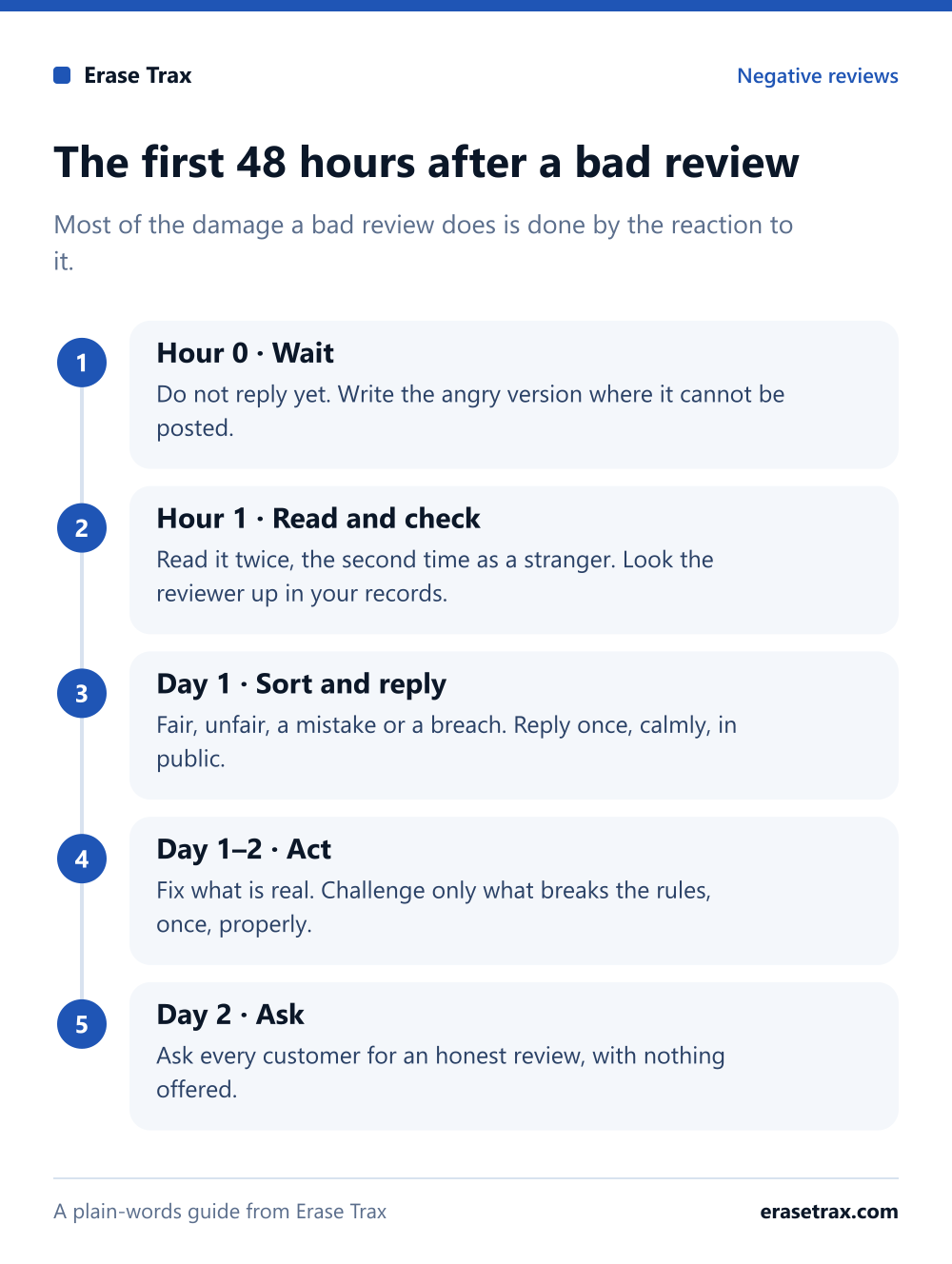
- Hour 0 · WaitDo not reply yet. Write the angry version where it cannot be posted.
- Hour 1 · Read and checkRead it twice, the second time as a stranger. Look the reviewer up in your records.
- Day 1 · Sort and replyFair, unfair, a mistake or a breach. Reply once, calmly, in public.
- Day 1–2 · ActFix what is real. Challenge only what breaks the rules, once, properly.
- Day 2 · AskAsk every customer for an honest review, with nothing offered.
The first 48 hours, step by step.Save the graphic
Read it twice: once as yourself, once as a stranger
When you come back, read the review slowly, twice. The first time, read it as yourself, and let yourself notice everything that feels unfair. The second time, read it as a stranger who is deciding whether to book you next week and has never heard of your business. That second reading is the one that matters, because that is the person your reply is really for.
Ask yourself what the stranger takes away. Usually it is much less than you fear. A stranger does not know the history, does not care about the details you would argue over, and is mostly looking for one thing: if something goes wrong with this business, will they sort it out? A single bad review on a profile with plenty of good ones rarely decides anything on its own, though how you answer it often does.
Work out which of four reviews this is
Almost every bad review falls into one of four groups, and each one needs a different response. Getting the group right is most of the work.
- A fair complaintsomething really did go wrong. The job was late, the food was cold, the invoice was a surprise. You may disagree with the tone, but the core is true.
- An unfair complainta real customer, but a version of events you would not recognize, or a reaction out of all proportion to what happened.
- A mistakethe review is meant for a different business with a similar name, a different branch or the company that used to be at your address.
- A breachthe reviewer was never a customer, is a competitor or a former employee, names your staff, is abusive, or the review is one of a sudden flood from strangers.
The first two groups are the platform working as intended, however painful. Google, Yelp and Trustpilot all keep genuine opinions up, harsh ones included, and no amount of reporting changes that. The last two are different: they violate the platform’s own policies, and they can come down. Our guide to what Google reviews can be removed goes through the grounds in detail.
Check your records before you decide
Before you put the review in a group, look it up. Search your bookings, orders, invoices, job sheets or appointment diary for the name, and for anything around the date the review describes. Ask the people who were working that day. You are trying to answer one question: did this person actually deal with us?
Picture an invented example. You run a small heating firm and a review says your engineer turned up three hours late and left a mess. You check the diary: there is a job under that surname, the engineer was indeed late because of the job before, and the customer phoned to complain at the time. That is a fair complaint, and the right answer is an apology and a fix.
Now picture the same review, but there is no job under that name, no job on that street, and nothing that week that matches what the review describes. That is not proof of anything on its own (reviewers do not always use their real name), but it is the first sign that you may be looking at a mistake or a breach, and it changes what you do next. Write down what you found either way. If the review ever needs to be challenged, that note is where it starts.
Write the reply the stranger needs to read
Now you are ready to reply. Remember who it is for. The reviewer has probably moved on; the people who matter now are the next hundred who will read the review and your answer side by side. What those readers judge is whether you come across as reasonable, much more than whether you were right.
A good reply is short, calm and specific. It thanks the person, acknowledges what went wrong (if anything did), says what you have done or will do, and offers a direct route to sort it out. It never argues the details in public, never discloses anything about the customer, and never accuses anyone of lying.
Illustrative, for a fair complaint: “You are right that our engineer arrived much later than we promised, and we are sorry. We have changed how we book back-to-back jobs so it does not happen again. Please call the office and ask for me. I would like to make this right.”
Illustrative, for a review you cannot match: “Thank you for the feedback. We have checked our records and cannot find a job that matches this. If you were a customer and we let you down, please contact us directly so we can look into it straight away.”
Notice that the second reply does not say “this is fake”. If the review turns out to be from a real customer under a different name, you will be glad you did not. If it really is fake, the calm reply already tells readers everything they need to know. We go deeper into tone and wording in our guide to responding to reviews.
If the complaint is fair, fix the thing, not just the review
A fair bad review is free consultancy, delivered rudely. It tells you something about your business that your other customers may have noticed and not mentioned. Before you worry about the rating, ask whether the same thing could happen again tomorrow, and if so, change whatever let it happen.
Then, if you can, put it right with the customer directly. Phone them, apologize, and offer a fair remedy. Do not make anything conditional on the review: offering a refund or a discount in exchange for changing or removing a review is against Google’s, Yelp’s and Trustpilot’s policies. Customers who feel properly looked after do often update their review on their own, though. That is the best outcome you can hope for, and the decision is theirs.
If the review is a mistake, say so kindly
Reviews meant for another business are more common than most owners think. A customer searches for a name, taps the wrong pin and writes the review on your profile. A polite public reply saying that you could not find the order, that you do not offer the service described, and that perhaps it was meant for another company often leads the reviewer to move it themselves. If they do not, a review about a different business does not belong on yours, and it can be challenged. We explain how these happen in a Google review left on the wrong business.
If the review violates policy, challenge it once, properly
If your records and your reading point to a breach (a stranger who was never a customer, a rival, a former member of staff, or a review that names your team or is plainly abusive), then the review may qualify for removal. Most owners lose time at this point by pressing the report button, picking a reason, and waiting for something to happen. Usually nothing does, because a report that says the review is unfair is a report about an opinion, and opinions stay.
What matters is the policy the review breaks. Five reports from five members of staff add nothing and can look like an attempt to clear criticism. Our review removal service handles the reviews that break a platform’s policies, and we only invoice a removal once it is verified on your live profile. If the review stays up, there is nothing to pay.
Owners always ask at this stage how long it will take. The platform decides in its own time, and anyone who quotes you a fixed number of days is guessing. We set out what makes a decision quicker or slower in how long does Google take to remove a review?.
What not to do, however tempting
Most of the damage a bad review does comes from the business’s reaction to it, and these are the reactions that do the most harm.
- Do not argue in public. A point-by-point rebuttal reads as defensive to everyone except you.
- Do not reveal anything about the customer, such as what they ordered, what they owed or what they said on the phone. It is their information, and disclosing it looks far worse than the review.
- Do not threaten legal action to get a review removed. In the United States, the FTC’s rule on reviews bars groundless legal threats used to suppress a negative review, and everywhere it turns a review into a story.
- Do not ask staff, friends or family to post good reviews to balance it out. Reviews from people connected to the business are a conflict of interest under the platforms’ policies and can put your own profile at risk.
- Do not offer anything in return for changing or deleting the review. That is an incentive, and every major platform forbids it.
- Do not delete your profile in the hope of starting again. You lose all your good reviews with it, and it rarely makes the bad one disappear for good.
Day two: ask the customers who are happy
By the second day the review is answered, the records are checked, and anything real is being fixed. Now look at the arithmetic of your rating, because that is where one bad review hurts most.
A worked example, as plain arithmetic: a profile with 10 reviews averaging 4.8 that receives one one-star review drops to about 4.45. The same review on a profile with 200 reviews averaging 4.8 moves it to about 4.78. The same review does far more damage to the smaller profile, which is why the best long-term protection against any single review is a steady flow of honest ones.
So start asking every customer, and not only the ones you know were delighted. Ask them all the same way, at the moment they are most satisfied, with nothing offered in return. Asking only the happy ones, or rewarding reviews, violates Google’s and Trustpilot’s policies, and Yelp asks businesses not to ask at all; we compare the policies in can businesses offer incentives for reviews?. Done fairly, asking is the single most effective thing most small businesses can do for their rating.
After the first 48 hours: keep watching
One bad review on its own tells you little, but a pattern tells you a lot. If you start to see the same complaint from different customers, the business has a problem worth solving. If you see a cluster of one-star reviews from strangers in a short space of time, you may be dealing with something else entirely, such as a coordinated attack or an extortion attempt, and the response is different; see review bombing and review extortion scams.
The owners who handle reviews best still get bad ones. What sets them apart is that they see each new review the day it arrives, reply to it within a day, and treat the whole profile as something that needs looking after rather than something that happens to them. If you do not have the time to watch every platform yourself, that is what a review monitoring service is for.
Your 48-hour checklist
- Wait an hour before you reply. Write the angry version somewhere it cannot be posted.
- Read the review twice, the second time as a stranger deciding whether to hire you.
- Check your records and ask your team: did this person deal with you, and when?
- Put it in one of four groups: fair, unfair, a mistake or a breach.
- Reply once, in public, calmly and briefly, for the next customer rather than this one.
- If it is fair, fix the cause and contact the customer, with nothing tied to the review.
- If it violates policy, challenge it once, properly, rather than reporting it repeatedly.
- On day two, start asking every customer for an honest review, with no reward.
And if you would rather someone else looked at it first, send us the review. The free audit comes back within 24 hours and tells you, in plain words, which group it is in and what, if anything, can be done about it.
About this guide
Written by the Erase Trax review team: specialists in review policy, working with businesses in the United States, the United Kingdom, Canada, Australia and the United Arab Emirates. Each guide is written against the platforms’ own published policies. Last reviewed .
- We never need your login
- We never buy, write or incentivize reviews
- The platform makes the final decision